







What's Happening?
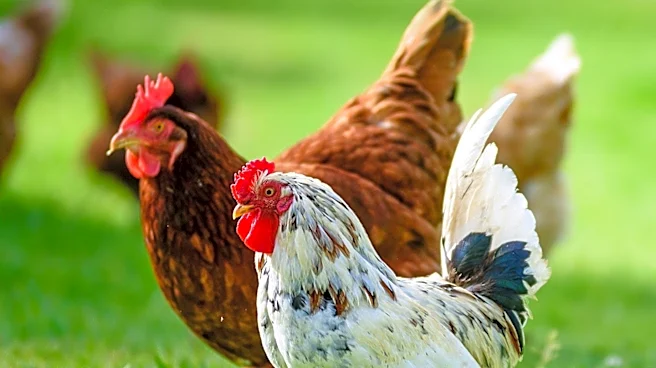
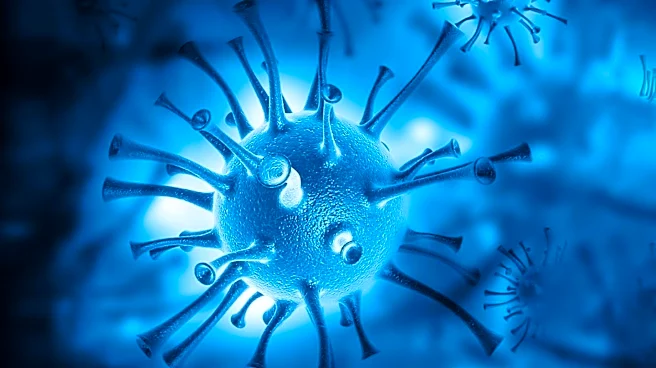
Dr. Keith Jarosinski, an associate professor and director of graduate studies in the Department of Pathobiology at the University of Illinois, is conducting research focused on Marek’s disease, a cancer in chickens caused by a herpesvirus. This chicken herpesvirus shares
similarities with human Epstein-Barr Virus (EBV) and Kaposi sarcoma-associated herpesvirus (KSHV), both of which cause cancers in humans. Dr. Jarosinski's primary goal is to develop strategies to prevent the spread of the Marek's disease virus in chickens, as current vaccines only reduce the disease's severity but do not stop its transmission. His work utilizes chickens as a natural host model to study how herpesviruses spread within a population, which is crucial because herpesviruses typically infect only one type of host, making natural animal models rare for human herpesviruses.
Why It's Important?
This research has significant implications for both animal health and human medicine. By understanding how the Marek's disease virus spreads in chickens, Dr. Jarosinski's team can gain insights into the general mechanisms of herpesvirus dissemination, which could inform strategies to control human herpesviruses. Preventing the spread of Marek's disease in chickens would directly benefit the poultry industry by reducing disease incidence, thereby helping to keep meat and egg prices stable. Furthermore, the development of more effective vaccines that stop viral transmission, rather than just mitigating symptoms, represents a major advancement in disease control. The use of a natural host model like chickens is critical for studying herpesvirus behavior, as it provides a real-world context that cannot be replicated in other laboratory models.
What's Next?
Dr. Jarosinski's future work aims to improve existing vaccines for Marek's disease to not only reduce symptoms but also halt the spread of the virus in chicken populations. This includes developing stable, lyophilized vaccines that are easier for farmers to use, eliminating the need for a liquid-nitrogen cold chain. The research will continue to identify viral proteins essential for transmission and determine their functions, which is crucial for developing new vaccine targets. Success in this area could lead to groundbreaking new vaccines for chickens and provide a blueprint for developing similar strategies against human herpesviruses. The ongoing studies are expected to yield publications that could significantly advance the field of vaccinology and herpesvirus research.
Beyond the Headlines
The comparative study of animal and human diseases, known as One Health, is underscored by Dr. Jarosinski's research. The similarities between chicken herpesviruses and human herpesviruses highlight the interconnectedness of health across species. This work could pave the way for novel approaches to combat human cancers linked to viruses, such as those caused by EBV and KSHV, by leveraging insights gained from a more accessible animal model. The challenges in vaccine development, particularly the need for vaccines that prevent transmission rather than just disease, are a recurring theme in infectious disease control. This research also emphasizes the importance of basic science in understanding fundamental biological processes, which can have far-reaching practical applications in both veterinary and human medicine.