


What's Happening?
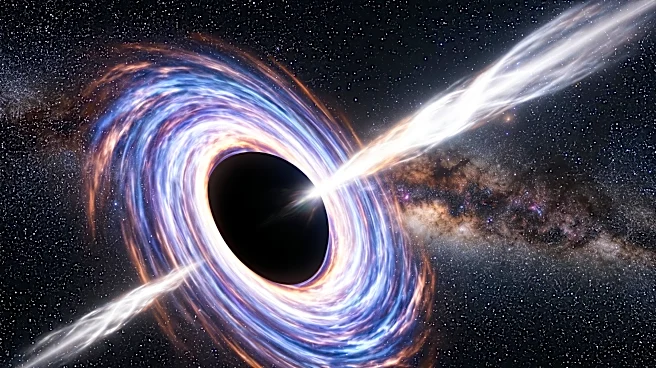
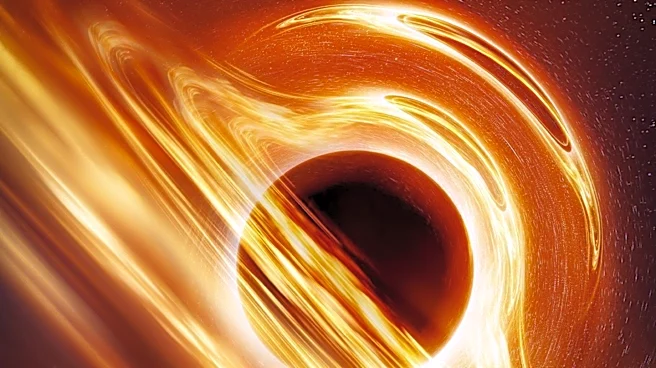
Astronomers have determined that Sagittarius A* (Sag A*), the supermassive black hole at the center of the Milky Way galaxy, is spinning at an exceptionally high rate. This rapid rotation is causing the spacetime surrounding it to warp into a shape resembling
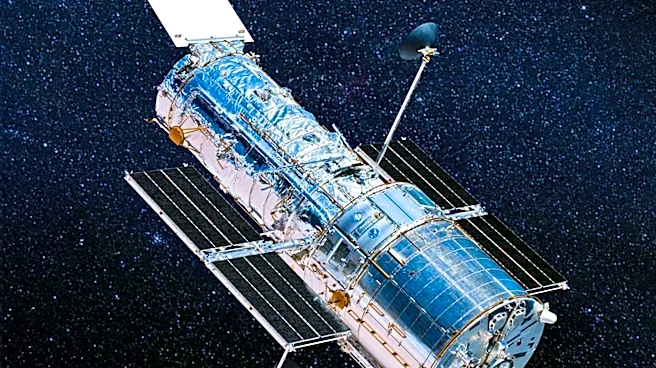
a football. This finding was made possible through a new study utilizing data from NASA's Chandra X-ray Observatory and the NSF's Very Large Array. While the mass of Sag A* has been estimated at approximately 4 million times that of the Sun, its spin rate has been more challenging to ascertain. The current research employed a method that analyzes X-ray and radio data to understand how material flows towards and away from the black hole, thereby indicating its rotational speed. This discovery provides strong evidence for a phenomenon that scientists have long theorized: black holes can significantly distort the fabric of spacetime around them.
Why It's Important?
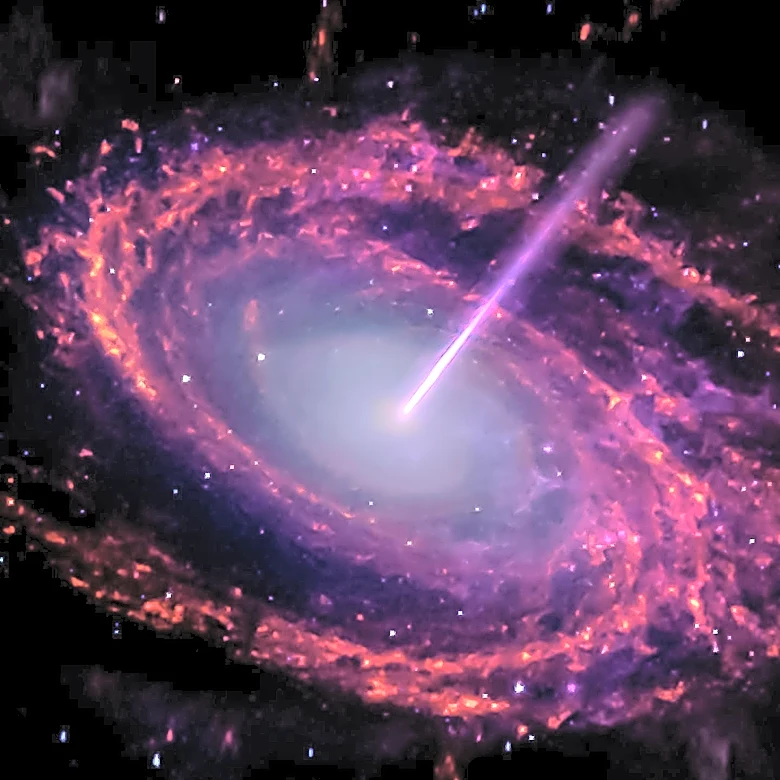
The rapid spin of Sagittarius A* has significant implications for understanding black hole behavior and galactic evolution. A black hole's spin is a crucial property, alongside its mass, that dictates its characteristics and influence. A fast-spinning supermassive black hole can act as a powerful energy source, capable of producing narrow outflows known as jets. These jets, when the black hole's spin energy is extracted, can profoundly impact their surroundings. Although Sag A* is currently considered relatively quiet, this new understanding of its rapid spin suggests it possesses the potential to become much more active in the future. Such activity could have far-reaching effects on the gas and dust within the galactic center, potentially influencing star formation and the overall dynamics of the Milky Way.
What's Next?
Scientists plan to continue their observations of Sagittarius A* using the Chandra X-ray Observatory. The ongoing study aims to further refine the understanding of this supermassive black hole and its role within the Milky Way galaxy. Future research will likely focus on monitoring any changes in its activity levels and investigating the mechanisms through which its rapid spin might translate into observable phenomena, such as the generation of powerful jets. Understanding the interplay between a black hole's spin and its environment is crucial for developing more comprehensive models of galaxy formation and evolution. Continued data collection and analysis will help astronomers predict potential future activity and its impact on our galaxy.
Beyond the Headlines
The discovery of Sagittarius A*'s rapid spin and its effect on spacetime offers a deeper insight into the fundamental physics governing the universe. The concept of spacetime warping, a prediction of Einstein's theory of general relativity, is vividly demonstrated by this observation. Beyond its immediate astronomical implications, this research contributes to our broader understanding of extreme gravitational environments and the energy extraction processes from black holes. The potential for Sag A* to become more active in the future highlights the dynamic nature of galactic centers and the profound influence these colossal objects exert over cosmic structures. This ongoing exploration pushes the boundaries of our knowledge about the most enigmatic objects in the cosmos.