



What's Happening?
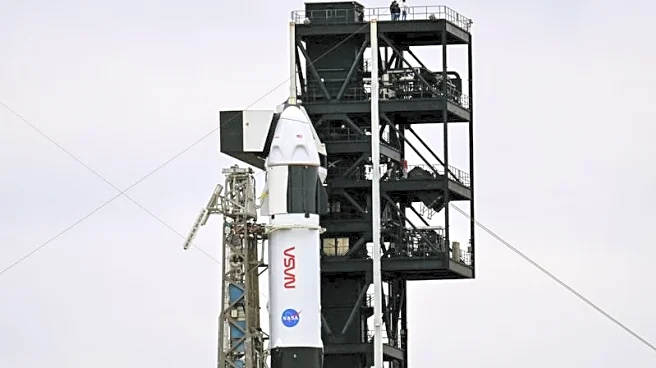
NASA has successfully launched the SpaceX Crew-12 mission to the International Space Station (ISS) from Cape Canaveral Space Force Station in Florida. The mission, part of NASA's Commercial Crew Program, involves a SpaceX Falcon 9 rocket carrying the Dragon
spacecraft. Onboard are NASA astronauts Jessica Meir and Jack Hathaway, ESA astronaut Sophie Adenot, and Roscosmos cosmonaut Andrey Fedyaev. The launch took place on February 13, 2026, at 5:15 a.m. EST. This mission marks the twelfth crew rotation of the SpaceX Dragon spacecraft and Falcon 9 rocket to the ISS. The crew will conduct various experiments and technology demonstrations aimed at benefiting life on Earth and in orbit, as well as advancing human exploration efforts to the Moon, Mars, and beyond.
Why It's Important?
The successful launch of the SpaceX Crew-12 mission underscores the ongoing collaboration between NASA and private companies like SpaceX in advancing space exploration. This mission is crucial for maintaining a continuous human presence on the ISS, which serves as a vital platform for scientific research and international cooperation. The experiments and technology demonstrations conducted by the crew are expected to yield insights that could enhance life on Earth and support future missions to the Moon and Mars. The involvement of international partners, such as the European Space Agency and Roscosmos, highlights the global nature of space exploration and the shared commitment to advancing human knowledge and capabilities in space.
What's Next?
Following their arrival at the ISS, the Crew-12 astronauts will begin their scheduled experiments and technology demonstrations. These activities are designed to support NASA's long-term goals of returning humans to the Moon and eventually sending crewed missions to Mars. The data and experiences gained from this mission will inform future space exploration strategies and technologies. Additionally, the success of Crew-12 will continue to bolster the Commercial Crew Program, encouraging further collaboration between NASA and private aerospace companies. The mission's progress will be closely monitored by space agencies and stakeholders worldwide, with potential implications for future international partnerships and space policy developments.