




What's Happening?
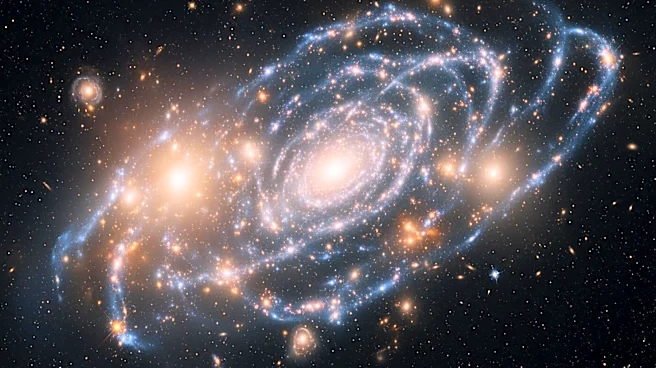
Researchers from the Technical University of Munich, Ludwig Maximilians University, and the Max Planck Institutes have discovered a superluminous supernova, named SN Winny, located about 10 billion light-years away. This supernova is unique because it appears
five times in the sky due to gravitational lensing, a phenomenon where the gravity of foreground galaxies bends the light from the supernova, creating multiple images. By measuring the time delays between these images, scientists aim to calculate the universe's expansion rate, known as the Hubble constant. This discovery provides a new method to measure the expansion rate, potentially resolving discrepancies between existing methods.
Why It's Important?
The discovery of SN Winny is significant as it offers a new, independent method to measure the Hubble constant, which is crucial for understanding the universe's expansion. Current methods, such as the cosmic distance ladder and cosmic microwave background analysis, have produced conflicting results, known as the Hubble tension. The new method using gravitationally lensed supernovae could provide more accurate measurements, as it involves fewer assumptions and systematic uncertainties. Resolving the Hubble tension is vital for cosmology, as it could lead to a better understanding of the universe's history and the forces driving its expansion.
What's Next?
Astronomers worldwide are continuing to observe SN Winny using both ground-based and space-based telescopes. These observations are expected to provide new data that could help resolve the Hubble tension. The research team plans to refine their measurements of the lensing galaxies' masses to improve the accuracy of the Hubble constant calculation. As more gravitationally lensed supernovae are discovered, this method could become a standard tool for cosmologists, potentially leading to a consensus on the universe's expansion rate.