







What's Happening?
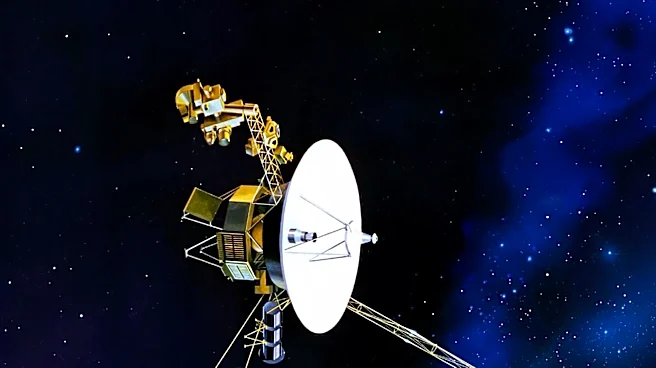
NASA has announced that Voyager 1, the most distant human-made object, will reach a significant milestone on November 18, 2026, when it will be exactly one light-day away from Earth. This distance, equivalent to 16,094,799,096 miles, marks the point where
light takes 24 hours to travel from the spacecraft to Earth. Launched in 1977, Voyager 1 has been exploring the outer reaches of the solar system and entered interstellar space in 2012. The spacecraft continues to send data back to Earth, although communication now involves a two-day delay due to the vast distance. This milestone highlights the extraordinary longevity and success of the Voyager mission, which was initially intended for close flybys of Jupiter and Saturn.
Why It's Important?
The achievement of Voyager 1 reaching one light-day from Earth underscores the remarkable engineering and scientific accomplishments of the mission. It demonstrates the capability of human technology to explore and communicate across vast distances in space. This milestone also serves as a testament to the durability and resilience of the spacecraft, which has been operational for nearly five decades. The data collected by Voyager 1 continues to provide valuable insights into the interstellar medium and the outer solar system, contributing to our understanding of the universe. The mission's success inspires future space exploration endeavors and highlights the importance of long-term scientific missions.
What's Next?
As Voyager 1 continues its journey through interstellar space, NASA will maintain communication with the spacecraft as long as possible. The mission team will continue to manage the spacecraft's limited power resources to keep its remaining instruments operational. Future milestones will focus on the continued collection of scientific data and the exploration of the interstellar medium. The mission's longevity and success will likely influence the design and planning of future deep-space missions, emphasizing the importance of robust engineering and long-term mission planning.