



What's Happening?
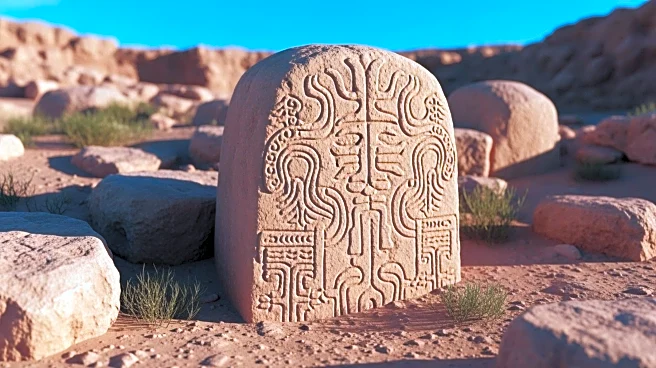
Recent archaeological findings at Karahan Tepe in southeastern Anatolia have revealed a complex prehistoric site featuring T-shaped pillars, underground chambers, and sophisticated iconography, dating back to between 9,600 BC and 8,000 BC. These discoveries
suggest that advanced social coordination and monumental construction occurred long before the advent of agriculture and writing. The site, part of a broader network of similar locations in the region, challenges traditional narratives of linear technological progress, showing a peak in complexity followed by a decline and deliberate burial of structures.
Why It's Important?
The findings at Karahan Tepe are significant as they challenge established archaeological models that associate social complexity with the development of agriculture and writing. The evidence of advanced construction and social organization in a pre-agricultural society suggests that early human groups were capable of significant achievements without the technologies traditionally thought necessary for such developments. This could lead to a reevaluation of how historians and archaeologists understand the evolution of human societies, potentially reshaping theories about the origins of civilization and the factors that drive social complexity.
What's Next?
Ongoing excavations and research at Karahan Tepe are expected to continue uncovering new insights into prehistoric societies. Future studies may focus on analyzing ancient DNA, isotopic data, and material residues to better understand the people who built these structures and their way of life. As more of the site is excavated, researchers hope to uncover additional evidence that could further illuminate the social and cultural dynamics of the time. These efforts may also lead to broader investigations into other similar sites in the region, contributing to a more comprehensive understanding of early human history.