




What's Happening?
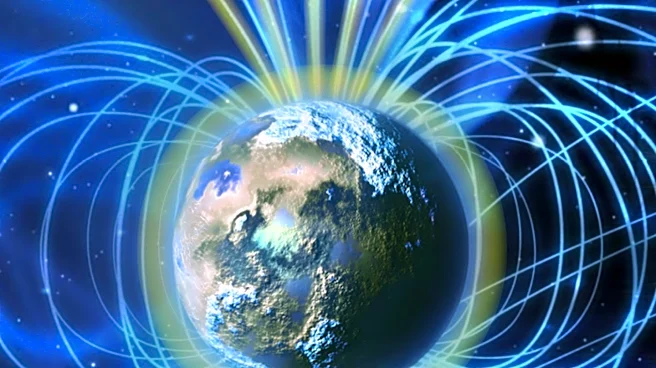
Researchers at the University of Washington have developed a comprehensive virtual Earth model that simulates the planet's geochemical systems over 5 billion years, from its formation to 500 million years into the future, with one critical exclusion:
life. Published in The Planetary Science Journal, this simulation models the exchange of chemicals between the Earth's core, mantle, crust, surface, and atmosphere. The goal is to establish a baseline for atmospheric conditions that can be explained without biological influence. By comparing observations of exoplanet atmospheres to this lifeless Earth model, astrobiologists can better identify chemical signatures that are uniquely indicative of life. The model accurately predicts 19 planetary properties, such as heat flow through the mantle, and can be adapted to study any rocky exoplanet.
Why It's Important?
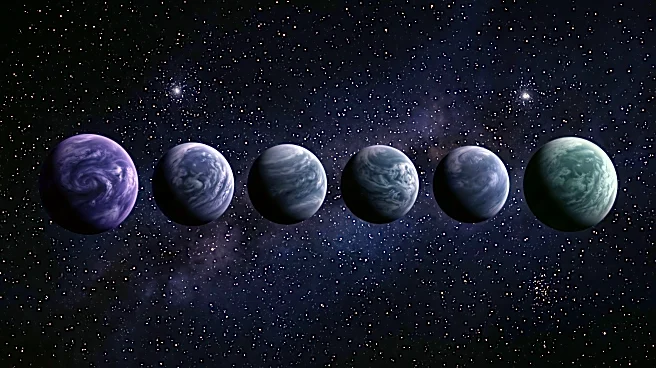
This new simulation is crucial for distinguishing between habitable planets and inhabited planets, a key challenge in astrobiology. As astronomers catalog thousands of exoplanets and analyze their atmospheres for signs of life, it becomes essential to differentiate between naturally occurring atmospheric compositions and those altered by biological processes. The model provides a vital tool for interpreting exoplanet data, helping scientists determine the probability that observed atmospheric conditions indicate life. This advancement could refine the search for extraterrestrial life, allowing researchers to prioritize exoplanets that show atmospheric anomalies inexplicable by non-biological means. It also informs the design of future telescopes, such as the proposed Habitable Worlds Observatory, by guiding what atmospheric signatures to look for.
What's Next?
The University of Washington's model will be applied to analyze data from observed exoplanets. Researchers can input basic details about a distant planet into the simulation to see if its observed atmosphere can be reproduced without the influence of life. If the model cannot match the observed atmospheric composition, it significantly increases the scientific interest in that particular exoplanet as a potential host for life. This tool is expected to guide future observational campaigns and help focus the efforts of upcoming advanced telescopes designed to study exoplanet atmospheres in greater detail. The ongoing refinement and application of this model will be critical in advancing the field of astrobiology and the quest to answer whether humanity is alone in the universe.
Beyond the Headlines
The development of a lifeless Earth simulation touches upon profound philosophical and scientific questions regarding the uniqueness of Earth's biosphere. By creating a 'control' Earth, scientists are not only seeking to find life elsewhere but also gaining a deeper understanding of how life fundamentally alters a planet's environment. This research highlights the intricate interplay between geological, atmospheric, and biological processes. It underscores the idea that life is not merely a passenger on a planet but an active sculptor of its environment. The ability to differentiate between abiotic and biotic planetary evolution could reshape our understanding of planetary habitability and the conditions necessary for life to emerge and thrive, offering new perspectives on Earth's own evolutionary history.