







What's Happening?
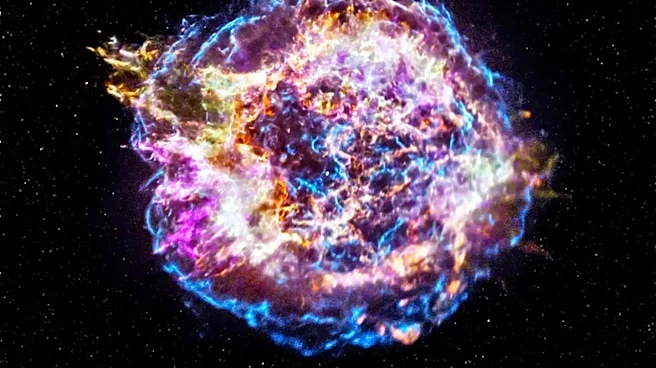
Scientists have potentially identified the first binary star system where both stars exploded as supernovas. The study focused on the supernova remnants IC 443 and G189.6+3.3, located in the constellation Gemini. Using data from NASA's Fermi Gamma-ray
Space Telescope and other sources, researchers found that both remnants are interacting with the same interstellar cloud, suggesting they originated from a binary system. This discovery provides new insights into the evolution and interaction of massive stars.
Why It's Important?
The identification of a binary system with twin supernova remnants offers a unique opportunity to study the life cycle of massive stars and their impact on the surrounding interstellar medium. Understanding these processes is crucial for developing models of stellar evolution and the formation of complex structures in the galaxy. The findings could also inform future research on the role of binary systems in the distribution of elements and the dynamics of galactic environments.
What's Next?
Further analysis of the supernova remnants IC 443 and G189.6+3.3 will help refine models of binary star evolution and the mechanisms driving supernova explosions. Researchers will continue to explore the interactions between these remnants and their environment, potentially uncovering new details about the history and future of the binary system. The study may also inspire additional searches for similar systems, expanding our understanding of stellar phenomena.
Beyond the Headlines
The discovery of twin supernova remnants highlights the complexity and diversity of stellar systems in the galaxy. It underscores the importance of interdisciplinary collaboration in astronomy, combining data from multiple observatories and scientific fields. The study also raises questions about the frequency and distribution of such systems, prompting further investigation into the cosmic factors influencing star formation and death.