

What's Happening?
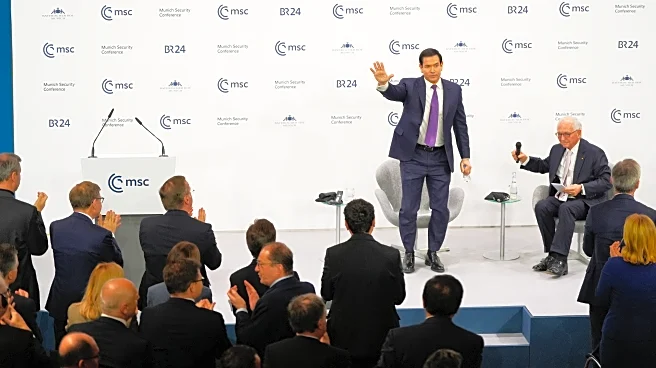
Secretary of State Marco Rubio attended the Munich Security Conference, where he delivered a speech addressing U.S. foreign policy and its role in Europe. His speech was well-received, earning applause and a standing ovation. Rubio emphasized that the U.S. remains
a committed partner to Europe, despite concerns raised by the Munich Security Report 2026. The report had suggested that U.S. policies under President Trump were disrupting the international order. Rubio countered these claims by stating that the U.S. prioritizes national interests over a so-called global order, which he argued has failed to address pressing global issues. He also criticized the United Nations for its lack of effective solutions. Rubio reassured the audience of the U.S.'s dedication to ending the war in Ukraine and managing relations with China, highlighting areas of potential cooperation and conflict management.
Why It's Important?
Rubio's address at the Munich Security Conference is significant as it seeks to alleviate European concerns about U.S. foreign policy under President Trump. The speech underscores the U.S.'s commitment to its European allies and its role in global security, particularly in the context of ongoing tensions with Russia and China. By emphasizing national interests and critiquing global institutions, Rubio's remarks reflect a shift in U.S. foreign policy that could impact international relations and alliances. The reassurance provided by Rubio may help stabilize transatlantic relations and foster cooperation on shared challenges, such as security threats and geopolitical tensions.
What's Next?
Following Rubio's speech, it is likely that diplomatic efforts will continue to strengthen U.S.-European relations. The U.S. may engage in further discussions with European allies to address concerns raised by the Munich Security Report and to reinforce its commitment to collective security. Additionally, the U.S. may pursue diplomatic channels to manage its relationship with China, focusing on areas of mutual interest while addressing potential conflicts. The outcomes of these efforts could influence future international policies and the stability of global alliances.