






What's Happening?
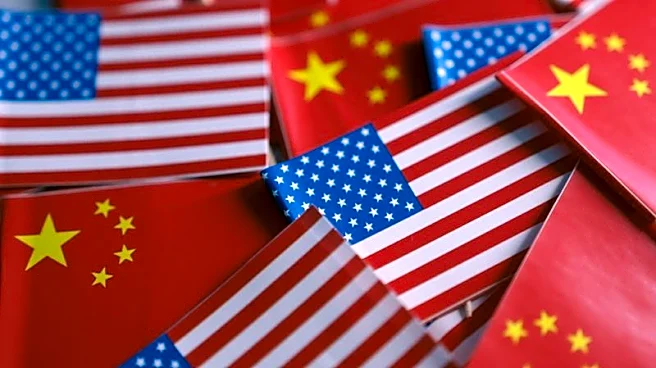
The Biden administration's sweeping export controls on advanced semiconductor manufacturing equipment to China, implemented in October 2022, have inadvertently spurred China's efforts to develop its own domestic chipmaking capabilities. These controls prevent
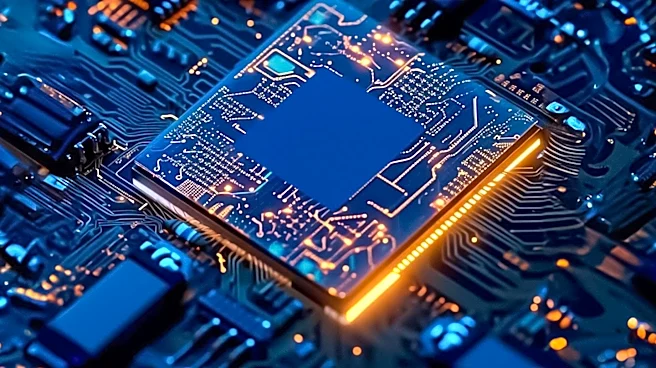
major suppliers like TSMC and Samsung from shipping advanced lithography equipment to Chinese chipmakers. While the policy aimed to slow Chinese AI development by creating a bottleneck at the foundry layer, it has instead provided clarity to China that the U.S. will not voluntarily supply advanced equipment. This definitive stance has focused Chinese investment and accelerated their timeline for achieving semiconductor independence. For instance, SMIC, China’s leading foundry, successfully produced Huawei’s Kirin 9000s chip on a 7nm-equivalent process in 2023 using deep ultraviolet (DUV) lithography, despite the constraints, demonstrating that U.S. controls have slowed but not halted Chinese progress.
Why It's Important?
This development is significant for U.S. industries and national security as it highlights the complex and often counterintuitive outcomes of geopolitical trade restrictions. While the U.S. intended to maintain its technological lead and curb China's military and AI advancements, the controls have galvanized China's domestic semiconductor industry. This could lead to a more self-reliant China in critical technology sectors, potentially reducing its dependence on U.S. and allied suppliers in the long term. For U.S. companies like Nvidia, the export controls have effectively eliminated a significant portion of their China AI accelerator market, shifting their focus to non-China demand. The long-term impact could be a more bifurcated global technology landscape, with two distinct supply chains and technological ecosystems, potentially affecting global trade dynamics and innovation pathways.
What's Next?
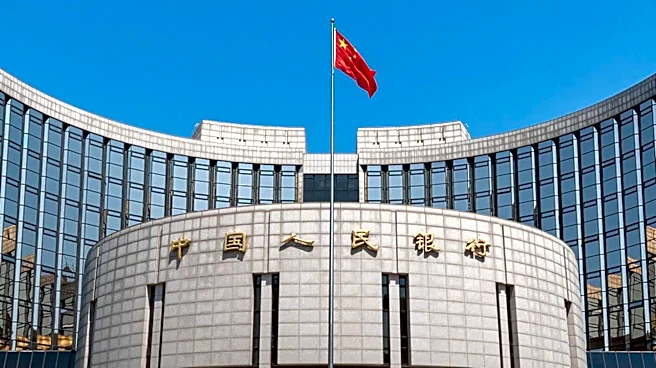
China is expected to continue increasing its investment in domestic research and development, particularly in chips, industrial machinery, and high-end scientific instruments, to achieve greater self-reliance. The U.S. will likely continue to monitor China's progress and potentially adjust its export control policies. The success of China's strategy will depend on whether its basic research climbs significantly, if companies fund long-term science beyond product development, and if the U.S. maintains steady research funding. The global technology landscape will likely see continued competition and strategic maneuvering between the U.S. and China, with other countries navigating this rivalry by hedging their bets and seeking to benefit from both technological blocs.
Beyond the Headlines
The U.S. export controls raise deeper questions about the effectiveness of technology-based industrial policy in a globally interconnected world. While intended to create a strategic advantage, such policies can inadvertently foster resilience and innovation in targeted nations. This situation underscores the ethical and strategic dilemmas of using technological leverage as a tool of foreign policy. It also highlights the potential for a 'decoupling' of technological ecosystems, which could have profound implications for global standards, interoperability, and the pace of technological advancement. The long-term shift could be towards a world where technological leadership is more distributed, and national security concerns increasingly drive technological development and supply chain decisions.