




What's Happening?
The State of Montana has formally requested the U.S. Ninth Circuit Court of Appeals to reverse a preliminary injunction that currently permits the American Prairie Foundation to graze bison on three federal allotments in Phillips County. According to an announcement
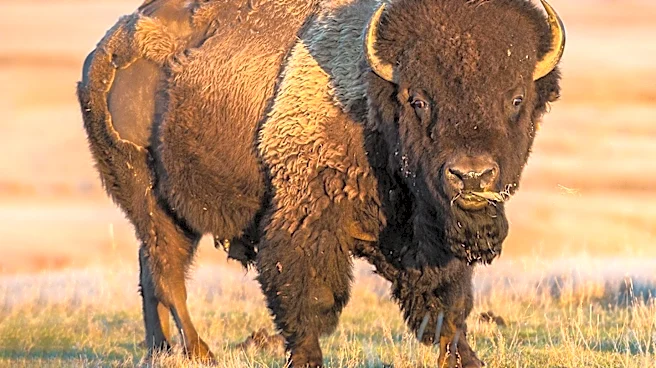
from Governor Greg Gianforte's office, the state filed its opening brief on November 2. Governor Gianforte stated that the district court fundamentally misunderstood the Taylor Grazing Act and that the Bureau of Land Management (BLM) made the correct decision in May 2026 to cancel American Prairie's bison grazing authorizations and reissued cattle-only permits. The injunction, granted in early September by U.S. District Judge Brian Morris, allows approximately 900 bison to remain on the Box Elder, Telegraph, and Whiterock Coulee allotments while the lawsuit proceeds. The state argues that the Taylor Grazing Act and related federal laws authorize grazing permits exclusively for domestic livestock, not for bison managed as wildlife for conservation.
Why It's Important?
This legal challenge has significant implications for land management, conservation efforts, and agricultural practices in Montana and potentially other Western states. The core of the dispute lies in the interpretation of federal grazing laws, specifically whether bison can be considered 'domestic livestock' under the Taylor Grazing Act. A ruling in favor of Montana could set a precedent limiting the types of animals allowed on federal grazing lands, impacting conservation groups that utilize such lands for wildlife reintroduction or management. Conversely, upholding the injunction could affirm a broader interpretation of grazing permits, potentially opening doors for more diverse land use. For ranchers, the outcome could affect competition for grazing resources and the long-standing balance between traditional livestock operations and wildlife conservation on public lands.
What's Next?
The U.S. Ninth Circuit Court of Appeals will now review the arguments presented by the State of Montana and the American Prairie Foundation. The court's decision will determine the immediate future of bison grazing on these federal allotments. Regardless of the Ninth Circuit's ruling, the case may continue to higher courts, potentially leading to a definitive legal interpretation of federal grazing laws concerning bison. This ongoing legal battle will likely influence future land management policies by the BLM and other federal agencies, as well as the strategies of conservation organizations and agricultural interests operating on public lands. The outcome could also prompt legislative action to clarify or amend existing grazing laws.
Beyond the Headlines
This case delves into the complex and often contentious relationship between wildlife conservation, agricultural interests, and federal land management in the American West. The debate over bison grazing on public lands is not merely about land use but also touches upon historical land rights, ecological restoration, and the economic viability of ranching communities. The legal interpretation of 'domestic livestock' highlights the challenges of applying decades-old legislation to modern conservation goals. The broader implications extend to how federal lands are managed for multiple uses, balancing economic activities with environmental protection and biodiversity. The resolution of this dispute could influence the future of bison populations in the West and shape the discourse around rewilding efforts on public and private lands.