






What's Happening?
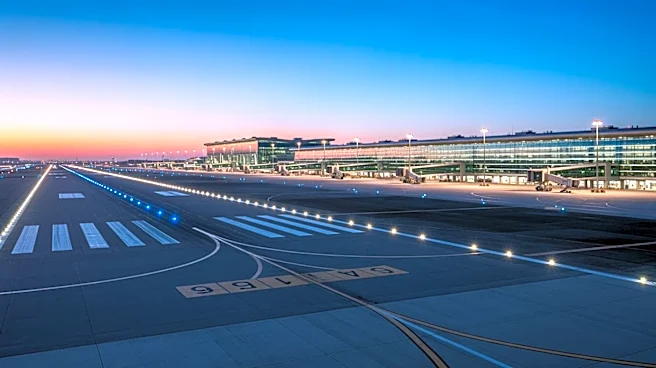
Xi'an Xianyang International Airport (XIY) is undergoing a significant infrastructure and network development program aimed at transforming it into a major international hub. The recent opening of Terminal 5 in February 2025 is a key milestone in the
airport's Phase III expansion project. This new terminal, covering over 700,000 square meters, is designed to handle an annual passenger throughput of 50 million. The broader expansion plan includes up to five runways, two terminal complexes, and a total terminal area of 1.5 million square meters, with a design capacity of 120 million passengers annually by 2030. The airport aims to handle 83 million passengers and 1 million tons of cargo by that year. The expansion supports both domestic and international growth, with a dense domestic route system providing a strong foundation for international expansion.
Why It's Important?
The expansion of Xi'an Xianyang International Airport is significant for several reasons. It positions the airport as a key player in China's Belt and Road Initiative, enhancing connectivity between western China and international markets. The development is expected to drive regional economic growth by promoting trade exchanges, industrial cooperation, and resource sharing. The increased capacity and improved connectivity will attract more investment from domestic and foreign enterprises, fostering industrial upgrades and economic growth in the western region. Additionally, the expansion will facilitate passenger travel and freight transport, boosting related industries such as tourism and commerce, and enhancing the regional economy's export orientation and competitiveness.
What's Next?
Looking ahead, the airport plans to leverage new aircraft technology, such as long-range narrowbodies and next-generation widebodies, to launch new routes to secondary cities in Europe and Asia. Hosting Routes Asia 2026 is expected to further support this growth by bringing together airlines, airports, and industry stakeholders to explore new route opportunities. The airport's strategy involves cooperation with major Chinese carriers like China Eastern Airlines and Hainan Airlines to improve connectivity and transfer efficiency. This collaborative approach is expected to enhance the airport's role as a major international hub.