





What's Happening?
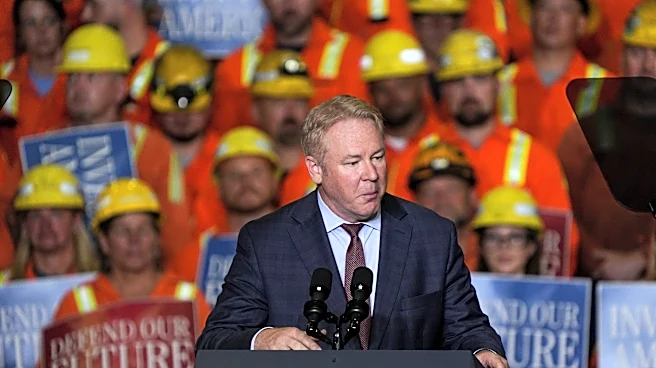
Republican Governor Larry Rhoden and Democratic challenger Dan Ahlers debated key issues at the South Dakota State Fair. Both candidates expressed criticism regarding President Trump’s decision to import 300,000 metric tons of ground beef. Governor Rhoden stated
his disappointment, despite generally supporting President Trump, calling the decision 'wrong-headed.' Ahlers accused President Trump of ignoring American producers and emphasized the need for stronger advocacy for farmers and ranchers. On education funding, Ahlers argued the state has not met its statutory commitment, citing a failure to match inflation rates. Rhoden countered, asserting that the Noem-Rhoden administration has funded education 7.6 percent above statutory requirements over the past eight years. The debate also touched upon Amendment I, a proposal to repeal expanded Medicaid in South Dakota if federal funding drops below 90 percent. Ahlers advocated for fighting to maintain Medicaid, while Rhoden clarified that Amendment I would not automatically end expansion but would remove a constitutional provision, requiring further action.
Why It's Important?
This debate is crucial as it highlights significant policy differences between the gubernatorial candidates on issues directly impacting South Dakotans. The discussion on beef imports is particularly relevant to the state's agricultural sector, a cornerstone of its economy. Both candidates' opposition to President Trump's policy signals a potential shift in state-level political alignment with federal agricultural decisions, reflecting concerns about local producers. The debate over education funding directly affects schools, teachers, and students across the state, with differing views on whether current funding levels are adequate or meet statutory obligations. Furthermore, the discussion on Amendment I and Medicaid expansion has profound implications for healthcare access and the well-being of vulnerable populations in South Dakota. The outcome of this election will determine the state's direction on these critical economic, social, and healthcare policies, influencing the daily lives of its citizens.
What's Next?
With the election day scheduled for November 3 and early voting commencing on September 18, the debate at the State Fair marks a significant point in the campaign. Both Governor Rhoden and Dan Ahlers will likely continue to campaign vigorously, emphasizing their stances on these and other issues to voters. The candidates' comments on President Trump's beef import policy may resonate with agricultural communities, potentially influencing voting patterns in rural areas. Similarly, their positions on education funding and Medicaid expansion will be key considerations for families, educators, and healthcare advocates. Voters will have the opportunity to cast their ballots, with the outcome determining the leadership and policy direction of South Dakota for the coming term. The debate also sets the stage for further discussions and potential legislative actions on these contentious topics, regardless of who wins the governorship.
Beyond the Headlines
The debate reveals deeper currents within U.S. politics, particularly the tension between federal policies and state-level concerns. The bipartisan criticism of President Trump's beef import decision by both a Republican governor and a Democratic challenger in an agricultural state like South Dakota underscores the powerful influence of local economic interests on political discourse, even across party lines. This suggests that while national party platforms are important, state-level politicians often prioritize the specific needs and industries of their constituents. The ongoing disagreements over education funding and Medicaid expansion also reflect a broader national debate about the role of government in social welfare and public services, and how these responsibilities are funded and managed at the state level. The candidates' differing interpretations of voter mandates, particularly regarding ballot initiatives, highlight the persistent struggle between direct democracy and legislative interpretation, a recurring theme in American governance.