


What's Happening?
Francesca Albanese, the UN Special Rapporteur on the situation of human rights in the Palestinian territories occupied, recently visited Modena, Italy, as part of the Dig Festival. During her visit, Albanese presented an early preview of her upcoming
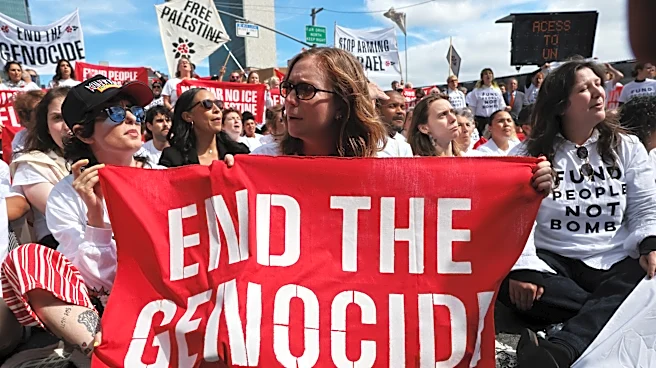
book project titled 'Falasteen,' which aims to narrate a century of Palestinian history. The event took place at Spazio Venturi, where she was met by dozens of citizens and associations, despite the absence of local institutional representatives. Albanese noted the contrast with a previous visit where she was honored by the mayor. She described 'Falasteen' as a project involving numerous artists and women, each contributing true stories of Palestinians who have experienced tragic events. Albanese also commented on the United Nations' current state, describing it as 'paralyzed' by the 'law of the strongest' imposed by the United States. Following her presentation, she moved to Piazza Torre for a welcome vigil organized by the Popular Consultation against war, rearmament, and genocide, where she was embraced by Palestinian families and supporters.
Why It's Important?
Francesca Albanese's visit and the presentation of her 'Falasteen' project highlight ongoing international discourse surrounding the Israeli-Palestinian conflict and the role of the United Nations. Her critical remarks about the UN's perceived paralysis and the influence of the United States underscore a broader sentiment among some international observers regarding global governance and power dynamics. The project itself, by focusing on a century of Palestinian history through personal narratives, aims to shape public understanding and potentially influence international opinion on the conflict. The absence of institutional welcome in Modena, contrasted with public support, reflects the polarized nature of discussions around the issue, even at local levels. This event contributes to the narrative that the UN's human rights mechanisms are often at the center of geopolitical tensions, with their representatives sometimes facing scrutiny or support depending on their stance on sensitive international issues.
What's Next?
The full release of Francesca Albanese's book 'Falasteen,' anticipated in the spring, will likely generate further discussion and debate regarding the Israeli-Palestinian conflict. The book's narrative approach, focusing on a century of Palestinian experiences, could become a significant resource for advocates and researchers, potentially influencing public discourse and policy discussions in various countries. Albanese's continued role as a UN Special Rapporteur means her statements and projects will remain under international scrutiny, particularly from those who criticize her stance on Israel. Future engagements and presentations related to 'Falasteen' are expected, continuing to draw attention to the human rights situation in the Palestinian territories and the broader geopolitical context. The ongoing debate surrounding the UN's effectiveness and impartiality, as highlighted by Albanese's comments, will also persist, with member states and civil society groups continuing to advocate for their respective positions.
Beyond the Headlines
The presentation of 'Falasteen' by Francesca Albanese delves into the ethical and cultural dimensions of historical narrative and memory in conflict zones. By compiling personal stories, the project seeks to humanize the Palestinian experience, potentially challenging dominant narratives and fostering empathy. This approach raises questions about the power of storytelling in international relations and its capacity to influence perceptions and policy. The controversy surrounding Albanese's past statements and the mixed reception she receives underscore the deep divisions and sensitivities inherent in the Israeli-Palestinian conflict. Her work, and the reactions to it, reflect a broader struggle over historical interpretation and the legitimacy of international bodies in addressing such complex issues. The project also highlights the role of cultural and literary initiatives in diplomatic and human rights advocacy, demonstrating how art and narrative can serve as platforms for political and social commentary, often sparking both support and opposition.