




What's Happening?
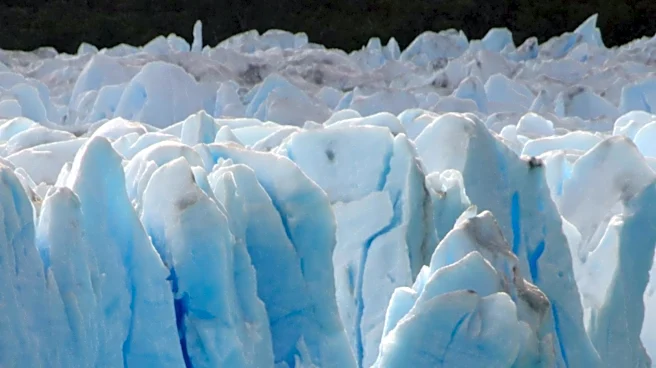
The glacial ice on Puncak Jaya in Indonesia's Sudirman Range, one of the few equatorial locations with year-round ice, has dwindled significantly, with remaining patches too small to flow as glaciers. Satellite images from 1988 (Landsat 5) and 2026 (Landsat 9)
show a dramatic reduction in ice cover. In 1988, glaciers covered about 4.31 square kilometers; by September 2025, only about 0.09 square kilometers remained, representing roughly 2% of the 1988 extent. The glaciers have also thinned considerably, with the primary monitoring site on the East Northwall Firn dropping from 32 meters thick in 2010 to 4 meters in 2023, and the ice at this site completely disappearing by November 2024. Chris Shuman, a retired University of Maryland glaciologist, described the situation as a 'house of cards problem,' indicating an irreversible process once it begins.
Why It's Important?
The rapid disappearance of glaciers on Puncak Jaya serves as a critical indicator of global climate change, particularly in tropical regions. These glaciers are considered 'canaries in the coal mine' for their sensitivity to warming conditions. Their loss highlights the accelerating rate of ice melt worldwide, impacting global sea levels and regional water resources. For the U.S., while geographically distant, the implications are part of a larger global climate crisis that affects weather patterns, agricultural stability, and coastal communities. The scientific data gathered from Puncak Jaya contributes to a broader understanding of climate models and the urgency of addressing greenhouse gas emissions, influencing international climate policy discussions and domestic environmental strategies.
What's Next?
An aerial survey is planned for December 2026 to provide an updated estimate of the remaining ice on Puncak Jaya. Recent satellite studies suggest the complete disappearance of the main glacial ice areas could occur around 2030, though the Indonesian Agency for Meteorology, Climatology, and Geophysics (BMKG) estimates it could be much sooner, hastened by the current El Niño. Past El Niño years have severely impacted these glaciers, causing precipitation to fall as rain instead of snow, leading to faster melting. The 2023-2024 El Niño brought significant thinning, losing 2 to 4 meters of thickness per year. Scientists will continue to monitor these remnants, using the data to refine climate predictions and assess the effectiveness of global climate mitigation efforts.
Beyond the Headlines
The melting of Puncak Jaya's glaciers carries profound cultural and ecological implications. For indigenous communities in the region, these glaciers may hold spiritual significance and are integral to their traditional understanding of the environment. Ecologically, the loss of these unique high-altitude ice formations can impact local biodiversity and water cycles, potentially affecting ecosystems dependent on glacial meltwater. This situation underscores the interconnectedness of global climate systems and the far-reaching consequences of climate change, extending beyond scientific measurements to touch upon cultural heritage, ecological balance, and the long-term sustainability of diverse environments worldwide. It also highlights the ethical responsibility to address climate change for future generations.