



What's Happening?
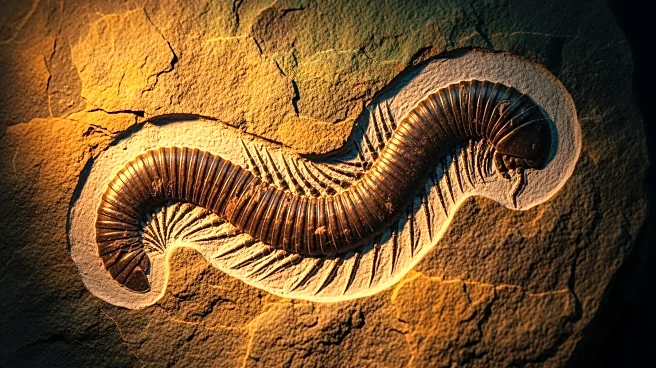
A team of researchers from the University of Cambridge has uncovered a colossal millipede fossil in Howick Bay, Northumberland, dating back 326 million years to the Carboniferous period. The fossil, belonging to the extinct genus Arthropleura, measures
approximately 75 centimeters but represents only a portion of the creature, which could grow up to 2.7 meters in length and weigh around 50 kilograms. This discovery challenges previous assumptions about prehistoric arthropods, particularly regarding their size and habitat. The fossil was found in a sandstone boulder after a cliff collapse exposed it, and it is the largest and most complete of its kind to date. The study, published in the Journal of the Geological Society, suggests that these creatures thrived in open woodlands near ancient waterways, feeding on decaying vegetation and possibly small invertebrates.
Why It's Important?
The discovery of the Arthropleura fossil is significant as it provides new insights into the evolution and ecology of prehistoric arthropods. Previously, scientists believed that the gigantic size of Paleozoic arthropods was primarily driven by high atmospheric oxygen concentrations. However, this fossil dates from a time before the known late Carboniferous oxygen peak, suggesting other factors such as abundant plant-based nutrition, a lack of terrestrial predators, and stable equatorial climates may have contributed to their massive growth. This finding prompts a reevaluation of the environmental conditions that supported large-bodied invertebrates and challenges existing theories about prehistoric ecosystems.
What's Next?
The fossil is now on display at the Sedgwick Museum of Earth Sciences, offering the public a glimpse into a world long gone. Researchers continue to study the fossil to better understand the behavior and biology of Arthropleura, as full adult skeletons remain elusive. The absence of fossilized heads limits the ability to fully reconstruct their feeding strategies and interactions with other species. Future studies may focus on uncovering more complete specimens and exploring the impact of climate shifts and competition with early reptiles on the extinction of these prehistoric giants.
Beyond the Headlines
The discovery of the Arthropleura fossil highlights the dynamic and complex nature of ancient ecosystems. It suggests that giant invertebrates were not confined to isolated swamps but roamed across vast open woodlands in equatorial Europe. This challenges the traditional view of prehistoric environments and underscores the importance of considering multiple factors in the evolution of species. The fossil also serves as a reminder of the evolutionary surprises that the ancient biosphere held, offering new perspectives on the diversity and adaptability of life on Earth.