



What's Happening?
A new study published in AgriEngineering highlights the transformative potential of agentic AI systems in precision agriculture. These systems are designed to replace traditional, human-dependent workflows with autonomous, goal-driven digital agents.
The study outlines a novel architecture that integrates artificial intelligence, IoT sensors, and autonomous systems into a unified agricultural model capable of continuous perception, decision-making, and action execution. Unlike current systems that rely on human interpretation, the proposed framework allows for real-time responsiveness to environmental changes, such as pest outbreaks or weather fluctuations. This shift from centralized analytics to distributed intelligence is expected to enhance scalability and efficiency in farming operations.
Why It's Important?
The adoption of agentic AI in agriculture addresses critical challenges such as climate volatility, resource scarcity, and labor shortages. By enabling autonomous decision-making, these systems can optimize resource use, reduce water consumption, and minimize chemical usage, thereby promoting environmental sustainability and economic efficiency. The framework's ability to operate under uncertainty and coordinate multiple agents toward shared objectives is particularly significant for large-scale farming operations. This technological advancement could lead to increased crop yields and reduced operational costs, benefiting both farmers and consumers.
What's Next?
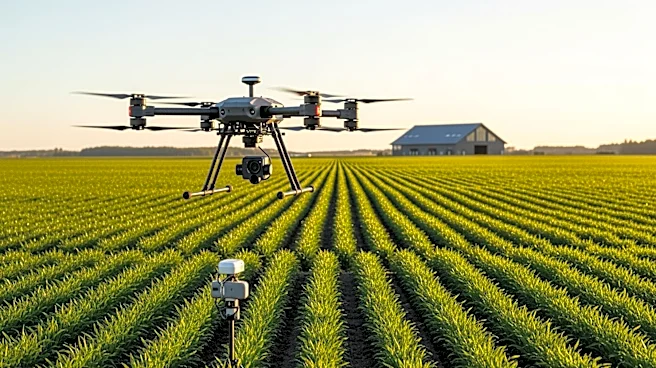
The transition to agentic AI-based precision agriculture will require overcoming challenges related to data quality, connectivity, and interoperability. Future research will focus on integrating these systems with physical platforms like UAVs and robotic equipment, enabling full automation. Long-term field studies are necessary to evaluate system performance under real-world conditions. Additionally, ensuring secure communication and data integrity will be crucial as these systems become more connected and autonomous.
Beyond the Headlines
The shift to autonomous agricultural systems raises ethical and regulatory considerations, particularly regarding accountability and safety. As AI systems gain greater autonomy, establishing governance mechanisms and ensuring regulatory compliance will be essential. The potential for job displacement in traditional farming roles also warrants attention, highlighting the need for workforce retraining and education in AI and robotics.