


What's Happening?
The James Webb Space Telescope has captured a stunning image of a region within the Carina Nebula, known as the 'Treasure Chest.' This area is a cometary globule, an isolated cloud of gas and dust with a dense head and a sweeping tail, resembling a wooden
chest with its lid open. The Treasure Chest contains a compact cluster of young stars, including a rare O-type star approximately 19 times the mass of the Sun. The cluster is estimated to be around 1.3 million years old, though some estimates suggest it could be as young as 100,000 years. The intense radiation and winds from nearby massive stars, including those in the star system Eta Carinae, have sculpted the nebula's current appearance. The Webb telescope's Near-Infrared Camera (NIRCam) has revealed the glow from these young stars, which are still embedded within the dusty clouds of the Treasure Chest.
Why It's Important?
This discovery is significant as it provides insights into the processes of star formation and the impact of young stars on their environments. The Carina Nebula is the nearest high-mass star-forming region, making it an ideal location for studying the full range of star formation. Understanding how young stars collect gas and expel it through outflows can help astronomers learn more about the evolution of galaxies and the formation of stellar systems. The findings from the Webb telescope contribute to our knowledge of how massive stars shape their surroundings, which is crucial for understanding the lifecycle of stars and the dynamics of nebulae.
What's Next?
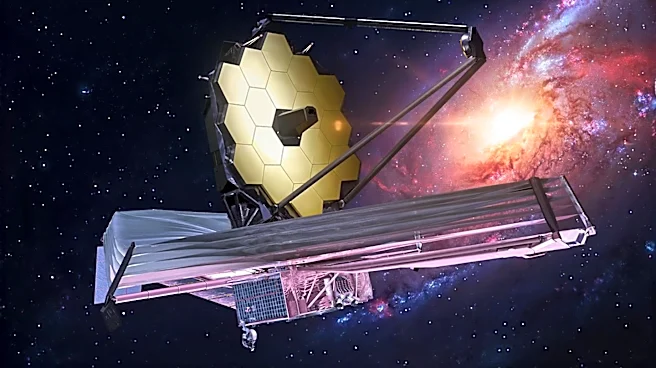
Astronomers will continue to study the Carina Nebula using the James Webb Space Telescope to gain further insights into the processes of star formation. The ongoing observing program aims to understand how young stars in the nebula collect and expel gas, which will help refine models of stellar evolution. As the Webb telescope continues to provide high-resolution images and data, researchers anticipate uncovering more about the interactions between stars and their environments, potentially leading to new discoveries about the formation and development of star clusters.
Beyond the Headlines
The observations of the Treasure Chest and the Carina Nebula highlight the intricate and dynamic nature of star-forming regions. The interplay between massive stars and their surrounding environments raises questions about the balance of forces that shape nebulae. The study of such regions can also inform our understanding of the conditions necessary for planet formation, as circumstellar discs around young stars are potential sites for planet development. The Webb telescope's ability to peer into these dense clouds offers a unique opportunity to explore the early stages of stellar and planetary evolution.