







What's Happening?
A recent study involving scientists from the Nicolaus Copernicus Astronomical Center of the Polish Academy of Sciences and the University of Lodz has found that the perceived spin rate of the black hole in the Cygnus X-1 system is highly dependent on the physical
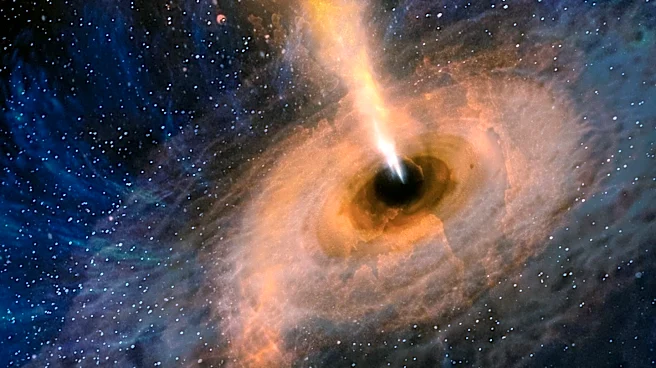
model used to interpret X-ray radiation data. Previous analyses suggested this black hole spun at nearly the fastest physically possible speed. However, by reanalyzing observations from the XRISM X-ray mission, along with simultaneous measurements from the NICER and NuSTAR telescopes, researchers discovered that while a simple model yielded a spin value of approximately 0.99 (on a scale where one is maximum spin), more detailed models produced values ranging from zero to 0.17. When data from all three telescopes were combined, virtually any spin value became possible. This discrepancy arises because the method of inferring black hole spin relies on radiation emitted by orbiting material, and the interpretation of this radiation is significantly influenced by assumptions about the hot plasma and the geometry of the accretion disk.
Why It's Important?
This finding highlights a fundamental problem in astrophysics: increasingly precise observational data do not necessarily lead to more precise answers if the underlying physical models used for interpretation are uncertain. The spin rate of black holes is a crucial parameter for understanding the evolution of massive stars and binary systems. Discrepancies in spin measurements, such as those observed in Cygnus X-1 compared to gravitational-wave observations of other black holes, indicate a gap in our understanding of these cosmic phenomena. Resolving these inconsistencies is vital for refining models of stellar evolution and the formation of black holes. The study also suggests that some features previously attributed to rapid spin might instead be due to the structure of the plasma or the geometry of the disk, which could necessitate a re-evaluation of numerous past black hole spin estimations.
What's Next?
The study suggests that future research will need to focus on developing more accurate and comprehensive physical models for interpreting X-ray radiation from black hole systems. This will involve a deeper understanding of the hot plasma above the accretion disk and its interaction with the disk itself. The researchers propose that there may be at least two regions of hot plasma, with some flowing away from the disk, which could explain the weak reflection of radiation and previously observed X-ray polarization. Further observations with advanced telescopes, coupled with refined theoretical models, will be necessary to reduce the uncertainty in black hole spin measurements. This ongoing effort will contribute to a more robust understanding of black hole physics and their role in the universe.
Beyond the Headlines
The challenge of accurately determining black hole spin underscores a broader scientific principle: the interpretation of observational data is inherently tied to the theoretical frameworks and models applied. This situation in astrophysics mirrors similar complexities in other scientific fields where indirect measurements require sophisticated modeling. The study's revelation that the inner edge of the disk is at most about 10 gravitational radii from the center, consistent with a low-spin black hole, suggests that the data might be better at determining the location of the disk's edge than the black hole's spin itself. This emphasizes the need for scientists to critically evaluate the assumptions embedded within their models, as these assumptions can profoundly influence the conclusions drawn from even the most precise data. The ethical implication is a call for transparency in scientific methodology, acknowledging the limitations and uncertainties inherent in complex astrophysical interpretations.