






What's Happening?
Laurel Yohe, Ph.D., an assistant professor of bioinformatics at The University of North Carolina at Charlotte, is a co-author of a significant bat genome study published in Nature. This study, the largest combined bat genome and fossil analysis ever conducted,
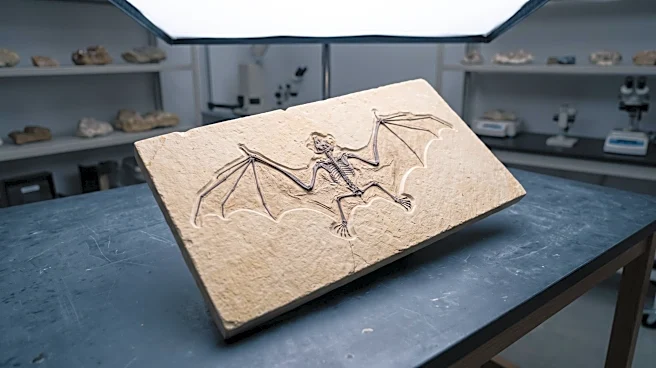
was led by the international Bat1K consortium, involving 137 researchers from 64 countries. The research integrated 103 bat genomes, representing all 21 recognized bat families, with 44 fossil specimens. The Bat1K consortium aims to sequence the genomes of over 1,400 living bat species, and this paper marks substantial progress toward that goal. The findings indicate that bats originated in Europe approximately 65 million years ago before spreading globally, and they also shed light on the evolution of echolocation and powered flight, suggesting these traits co-evolved earlier than previously believed.
Why It's Important?
This landmark study holds significant importance for several scientific fields and public health. By tracing the evolutionary origins of bats, researchers gain a deeper understanding of mammalian evolution and biodiversity. The insights into the co-evolution of echolocation and flight resolve long-standing scientific debates and provide a more accurate bat family tree. From a public health perspective, bats are known carriers of various lethal viruses, and understanding their genomic makeup and evolutionary history can offer crucial insights into their unusual disease tolerance. This knowledge is vital for predicting and mitigating potential health risks associated with emerging pathogens. Furthermore, Dr. Yohe's involvement highlights UNC Charlotte's contribution to global scientific research and its commitment to training future scientists in bioinformatics and pathogen study, which is critical for addressing global health challenges.
What's Next?
The Bat1K consortium will continue its ambitious goal of sequencing the genomes of over 1,400 living bat species, building upon the foundational work of this study. Dr. Yohe's ongoing research, including her work on the FOXP2 gene related to vocal learning and chemosensation in bats, will further explore the unique biological characteristics of these mammals. Her International Research Experiences for Students (IRES) program will continue to send U.S. students to Vietnam to study bat biodiversity and monitor pathogens, fostering the next generation of scientists in this critical field. The findings from this study are expected to stimulate further research into bat biology, disease ecology, and the development of new strategies for public health preparedness and conservation efforts globally.
Beyond the Headlines
Beyond the scientific discoveries, this study underscores the interconnectedness of global ecosystems and human health. Bats, often misunderstood, play crucial roles in their environments, and their unique biological adaptations, such as disease tolerance, offer potential avenues for biomedical research. The collaborative nature of the Bat1K consortium, involving researchers from numerous countries, exemplifies the power of international scientific cooperation in addressing complex global challenges. Ethically, the research also highlights the delicate balance between studying wildlife for human benefit and ensuring the conservation of these species, especially given their role as disease reservoirs. The long-term implications could include improved understanding of zoonotic diseases, better pandemic preparedness, and more effective conservation strategies for bat populations worldwide.