


What's Happening?
In July 2024, a magnitude 7.4 earthquake struck near Calama, Chile, causing significant damage and power disruptions. Unlike typical megathrust earthquakes that occur near the Earth's surface, this event originated at a depth of 125 kilometers within
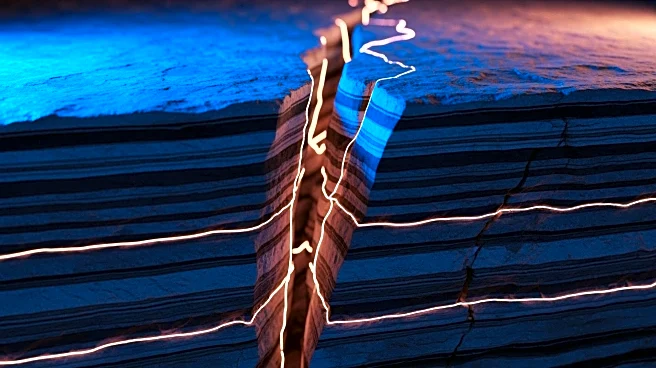
a subducting tectonic plate. Researchers from The University of Texas at Austin have identified a rare sequence of underground processes that intensified the earthquake's strength, challenging previous assumptions about intermediate-depth earthquakes. Traditionally, such earthquakes were thought to be triggered by 'dehydration embrittlement,' where water released from minerals weakens the rock. However, the Calama earthquake continued beyond expected temperature limits due to a 'thermal runaway' process, where friction-generated heat allowed the rupture to propagate further and faster.
Why It's Important?
The findings from this study have significant implications for earthquake hazard assessment and emergency preparedness. Understanding the mechanisms behind deep earthquakes can improve predictions of seismic events, potentially leading to better infrastructure design and early warning systems. The research highlights the need for updated models that consider the possibility of stronger shaking from intermediate-depth earthquakes, which could inform emergency response and long-term planning. This is particularly crucial for regions like Chile, where large earthquakes are a recurring threat. The study underscores the importance of international collaboration in advancing earthquake science and enhancing public safety.
What's Next?
The research team plans to continue studying the behavior of deep earthquakes to refine predictive models and improve risk forecasts. This involves deploying more seismometers and geodetic stations in earthquake-prone regions to monitor seismic activity and crustal deformation. The goal is to develop more accurate models that can estimate the potential strength of future earthquakes, guiding infrastructure resilience and emergency response strategies. The study's findings may also prompt further investigation into other regions with similar geological conditions, potentially leading to broader applications of the research.
Beyond the Headlines
The study challenges long-held beliefs about the limits of dehydration embrittlement and introduces the concept of thermal runaway as a significant factor in deep earthquake dynamics. This could lead to a reevaluation of seismic risk assessments globally, particularly in areas with complex tectonic settings. The research also highlights the role of advanced technology and international collaboration in uncovering new insights into natural phenomena, emphasizing the importance of continued investment in scientific research to address global challenges.