







What's Happening?
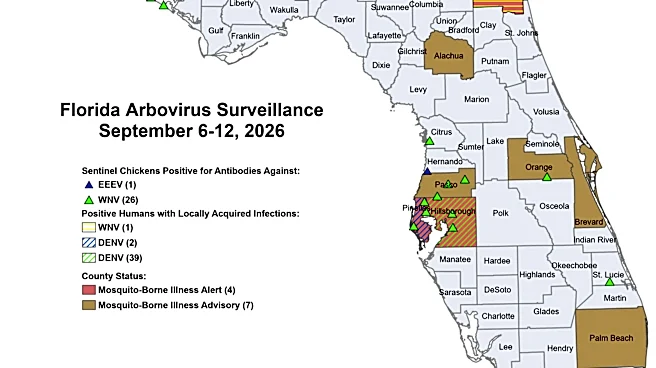
Hillsborough County, Florida, has reported its first dengue fever-related death, as the county accounts for 88% of Florida's locally acquired dengue cases, with 134 infections reported so far. Doctors at Tampa General Hospital have treated over 100 dengue patients,
noting severe symptoms like 'break-bone fever.' In response to the escalating situation, Hillsborough County Mosquito Management Services is conducting aggressive aerial and truck-based treatments to eliminate both adult mosquitoes and larvae. These efforts appear to be effective, with mosquito trap numbers decreasing in certain locations and adult mosquito samples testing negative for dengue over the past two weeks. Furthermore, laboratory tests confirm that infected female mosquitoes are not passing the virus to their offspring. County officials are urging residents to assist by eliminating standing water on their properties and using bug spray, as the Aedes aegypti mosquito, responsible for dengue transmission, primarily breeds in man-made containers.
Why It's Important?
The first dengue fever-related death in Hillsborough County underscores the severe public health threat posed by mosquito-borne illnesses in Florida. The high concentration of cases in Hillsborough County highlights a localized epidemic that requires immediate and sustained intervention. The aggressive mosquito control measures, including aerial and truck spraying, are crucial for reducing the mosquito population and breaking the chain of transmission. The positive indication that these efforts are working, with declining mosquito trap numbers and negative dengue tests in adult mosquitoes, suggests that coordinated public health responses can be effective. However, the continued need for public participation in eliminating breeding sites emphasizes that community engagement is vital for successful vector control. This situation also serves as a stark reminder of the potential for tropical diseases to establish themselves in new regions, particularly with changing climate patterns, posing a significant challenge to U.S. public health infrastructure.
What's Next?
Hillsborough County Mosquito Management Services will continue its intensive aerial and truck-based treatment campaigns to suppress mosquito populations. Public health officials will likely intensify their calls for community involvement, urging residents to consistently drain standing water and use personal protective measures like insect repellent. Ongoing surveillance will be critical to monitor the effectiveness of control measures and to detect any new cases or shifts in mosquito activity. The Florida Department of Health will continue to track dengue cases statewide and coordinate with local health departments. The experience in Hillsborough County may also inform strategies for other Florida counties and U.S. regions that could face similar dengue outbreaks in the future, emphasizing the importance of rapid response and integrated pest management techniques.
Beyond the Headlines
The dengue outbreak in Hillsborough County, culminating in a fatality, brings to light the increasing vulnerability of U.S. communities to diseases traditionally associated with tropical climates. This event highlights the interconnectedness of environmental factors, public health infrastructure, and individual actions in disease prevention. The 'break-bone fever' symptom described by doctors underscores the severe impact of dengue on patients, which can overwhelm healthcare resources. The reliance on public cooperation to eliminate breeding sites also points to a broader societal challenge: fostering collective responsibility for public health. As climate change continues to alter weather patterns and expand the range of disease vectors, such outbreaks may become more frequent, necessitating a re-evaluation of long-term public health strategies, funding for vector control, and public awareness campaigns across the nation.