



What's Happening?
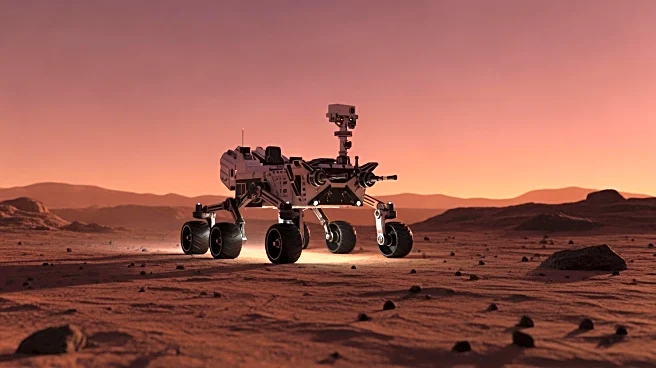
NASA's Science Mission Directorate (SMD) is preparing to launch a new program under the Planetary Science Division called Science Transport & Robotic Innovation for Deployment and Exploration (STRIDE). This initiative aims to solicit proposals from U.S.
industry for the design and development of advanced robotic systems capable of operating on the Martian surface. The program will focus on creating systems that can transport and deploy scientific payloads across Mars' challenging terrain. The solicitation will be part of the ROSES-2025 program, and NASA plans to award firm-fixed-price contracts based on the merit of the proposals and available funding. The program seeks to engage a wide range of participants, from established space hardware developers to terrestrial robotics companies, to explore scalable and adaptable mobility solutions for diverse mission scenarios.
Why It's Important?
The STRIDE program represents a significant step in advancing robotic exploration on Mars, which is crucial for future scientific missions and potential human exploration. By encouraging innovation in robotic mobility systems, NASA aims to enhance the capability to deliver scientific payloads efficiently across the Martian surface. This initiative could lead to the development of commercial systems that are not only cost-effective but also capable of operating in the harsh Martian environment. The program's focus on identifying capability gaps and advancing robotic exploration technology could have long-term benefits for the space industry, potentially leading to new partnerships and technological advancements that extend beyond Mars exploration.
What's Next?
NASA will issue a formal solicitation for the STRIDE program as part of the ROSES-2025 initiative. Interested parties will be able to submit proposals through a direct submission process via NSPIRES. The agency anticipates selecting multiple proposals for funding, although it reserves the right to make no awards if the proposals do not meet the program's criteria. As the program progresses, NASA will likely engage with selected participants to refine their designs and potentially move towards early-stage prototyping. The outcomes of these efforts could inform future Mars missions and contribute to the broader landscape of robotic exploration.