
What's Happening?
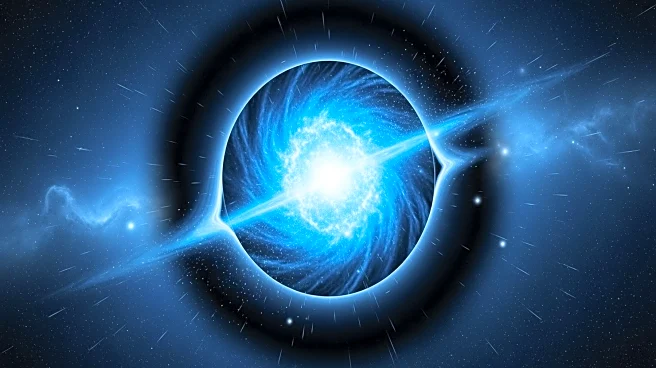
Astronomers have identified a new type of cosmic event known as Luminous Fast Blue Optical Transients (LFBOTs), which are caused by black holes shredding companion stars. The discovery was made through
the observation of a signal from an LFBOT designated AT 2024wpp, which was first spotted in 2024. These events occur when a black hole, with a mass up to 100 times that of the sun, completely destroys a nearby star in a matter of days. The resulting energy release is significantly higher than that of a typical supernova, ruling out previous theories that these events were caused by exploding stars. The LFBOTs are characterized by their bright blue light, visible across billions of light-years, and they last only a few days. The event AT 2024wpp was observed using the Gemini South observatory, revealing an excess of near-infrared light, a feature not associated with normal supernovas.
Why It's Important?
This discovery is significant as it provides a clearer understanding of the processes occurring in the universe involving black holes and their interactions with stars. The identification of LFBOTs as a result of Tidal Disruption Events (TDEs) offers insights into the extreme conditions and energy dynamics in such cosmic phenomena. This knowledge enhances our comprehension of black hole behavior and the lifecycle of stars, contributing to the broader field of astrophysics. The findings also challenge previous models of stellar explosions, prompting a reevaluation of how these high-energy events are powered. Understanding these processes can have implications for future astronomical research and the study of cosmic evolution.
What's Next?
Future research will likely focus on observing more LFBOTs to confirm the findings and refine the models of these events. Astronomers may seek to identify additional instances of TDEs to better understand the conditions that lead to such powerful explosions. The study of LFBOTs could also lead to advancements in detecting and analyzing other transient cosmic phenomena. As more data is collected, scientists will aim to determine the frequency of these events and their impact on the surrounding cosmic environment. Collaboration between observatories and the use of advanced telescopes will be crucial in furthering this research.