





What's Happening?
A new modeling report from the Joint Research Centre, published on October 12, 2026, explores the potential expansion of biobased chemicals and plastics by 2040. The report's assumptions include a 15% biobased output share, significant technological advancements,
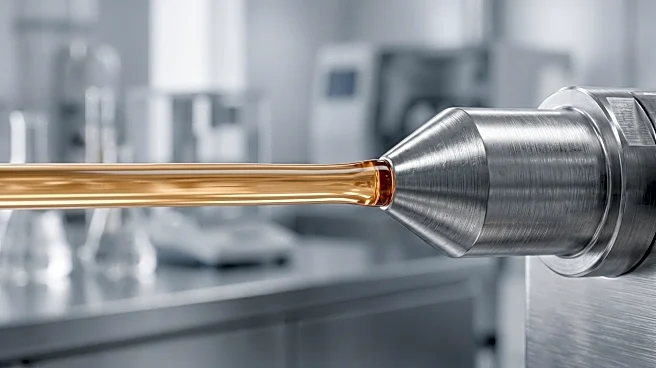
and increased utilization of non-food biomass. While the model projects a decrease in production emissions across the chemicals and plastics sectors, the consumption emissions footprint is expected to remain similar to the baseline, and the land footprint is projected to increase. This highlights a trade-off where environmental benefits in production may be offset by other factors. An earlier study by EPFL demonstrated a method to convert the hemicellulosic fraction of non-edible biomass into a polyester precursor with an 83% yield, producing polyesters with mechanical strength and gas barrier properties compatible with various manufacturing methods, including injection molding and extrusion. Chemical recycling of these polyesters through methanolysis was also demonstrated at 64°C.
Why It's Important?
The Joint Research Centre's findings are crucial for understanding the complex environmental implications of transitioning to biobased materials. While the reduction in production emissions is a positive step towards sustainability, the stable consumption emissions and increased land footprint indicate that a holistic approach is necessary. The report underscores that simply replacing fossil carbon with plant carbon does not automatically guarantee a fully circular economy. The EPFL study offers a promising avenue for creating high-performance, recyclable biobased polyesters from non-edible biomass, which could reduce reliance on fossil fuels and mitigate plastic waste. However, the need for standardized biodegradation studies and effective recovery infrastructure remains a significant challenge. The distinction between biobased origin and material behavior in different environmental settings is critical for accurate environmental assessments and policy development.
What's Next?
The Joint Research Centre's report suggests that future industrial strategies for biobased materials must consider a wider range of factors beyond just production emissions, including trade, demand, and biomass supply. Further research and development are needed to address the challenges of consumption emissions and land use. The EPFL study's success in creating recyclable polyesters from non-edible biomass points to the potential for innovative chemical solutions. However, scaling these technologies will require establishing robust collection systems and processing facilities for chemical recycling. Policy frameworks, such as the European Commission’s distinction between feedstock origin and material behavior, will continue to guide the development and assessment of biobased, biodegradable, and compostable plastics, emphasizing the need for comprehensive life cycle assessments.
Beyond the Headlines
The report and studies highlight a fundamental tension in the pursuit of a circular economy: while biobased materials offer a pathway to reduce reliance on fossil resources, their environmental impact is not always straightforward. The increase in land footprint, for instance, raises questions about sustainable land management and potential competition with food production. The distinction between depolymerization and complete biological conversion in environmental settings also underscores the ethical and scientific responsibility to avoid 'greenwashing' claims. True circularity requires not only innovative chemistry but also a complete overhaul of manufacturing, collection, and recovery systems. The success of these initiatives will depend on integrating molecular design with manufacturing processes, establishing clear recovery routes, and accurately assessing biomass demand at scale, ensuring that environmental benefits are realized throughout the entire material lifecycle.