



What's Happening?
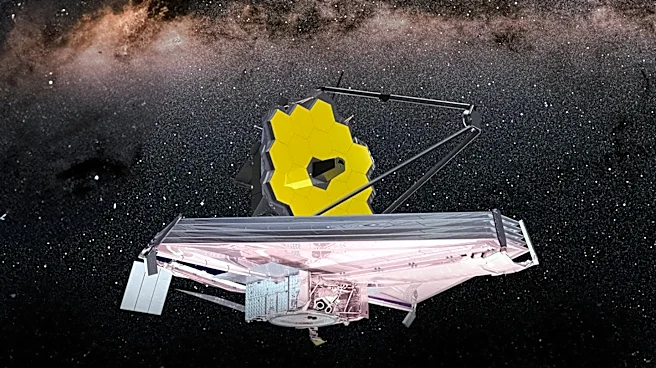
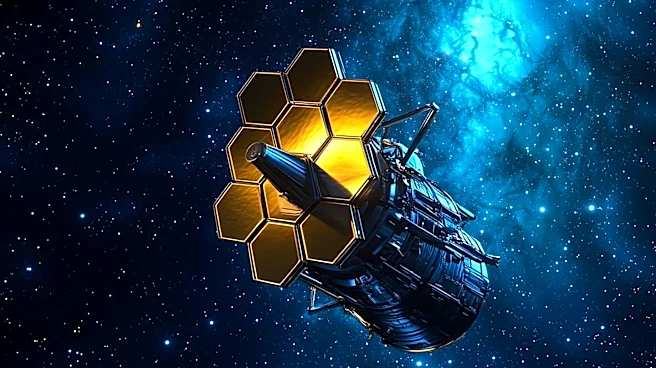
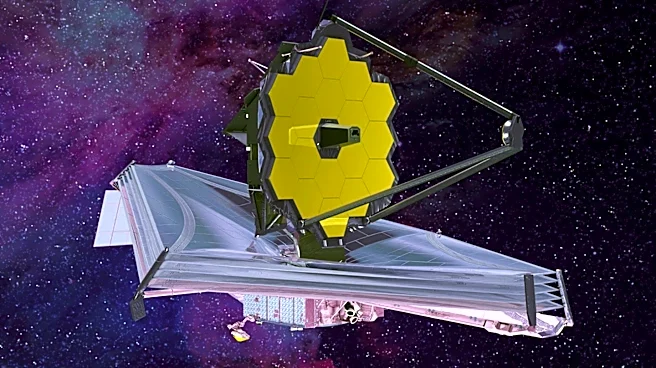
NASA's James Webb Space Telescope (JWST) has identified an unknown infrared spectral signature on Titan, Saturn's largest moon, and the dwarf planet Pluto. This discovery raises questions about the chemical processes occurring on these icy worlds. The
signal, detected during high-resolution infrared studies, does not match any known compounds, suggesting it could be an unknown molecular mixture, a new chemical process, or an exotic surface material. Researchers emphasize that the discovery is preliminary, and the substance remains unidentified. The finding is intriguing because Titan and Pluto, despite their differences, share extremely cold environments and complex organic chemistry. The detection of the same spectral feature on both bodies suggests that similar chemical processes may be at work, driven by sunlight, radiation, or interactions between atmospheric gases and icy surfaces.
Why It's Important?
The detection of the same unexplained signal on two different celestial bodies could indicate shared chemical processes throughout the outer Solar System. This discovery has significant implications for planetary science, as it could lead to a better understanding of planetary chemistry and insights into complex organic molecules. It may also improve models of icy worlds and guide future laboratory experiments and space missions. The James Webb Space Telescope's ability to uncover subtle chemical details that were previously beyond reach highlights its transformative impact on the study of exoplanets, galaxies, and Solar System bodies.
What's Next?
Researchers are working to determine the source of the mysterious signature through laboratory simulations, computer modeling, additional JWST observations, and comparisons with previous spacecraft data. Future planetary studies are expected to help identify the compound or compounds responsible for the spectral signature. Until then, scientists caution that the material remains unidentified, and further evidence is needed before drawing conclusions. The ongoing investigation will continue to expand our understanding of complex chemistry on icy worlds and its potential occurrence elsewhere in the Solar System.