




What's Happening?
Dr. Ke Yang, an assistant professor of systems engineering at Texas A&M International University (TAMIU), has been awarded a $200,000 grant from the National Science Foundation (NSF). The funding will support her research project titled “ERI: An Integrated
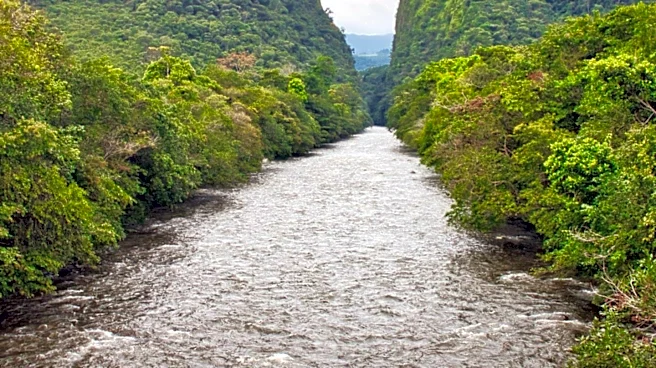
UAV-enabled Framework for Autonomous Sampling and Continuous Water Quality Monitoring.” This initiative focuses on utilizing unmanned aerial vehicles (UAVs), autonomous technology, and data-driven methodologies to enhance water quality monitoring in South Texas. Specifically, the research will use the Rio Grande in the Laredo region as a field environment to develop methods for short- and long-term water quality prediction, aiming for earlier identification of potential environmental concerns. Dr. Claudia San Miguel, TAMIU's provost and senior vice president for academic affairs, highlighted that this award underscores the university's increasing contributions to research addressing critical regional challenges.
Why It's Important?
This NSF grant is significant for several reasons. Firstly, it addresses a critical environmental issue in South Texas by focusing on water quality monitoring in the Rio Grande, a vital water source for the region. Improved monitoring capabilities can lead to better public health outcomes and environmental protection. Secondly, the project integrates cutting-edge technologies such as UAVs and autonomous systems, which can revolutionize how environmental data is collected and analyzed, potentially setting new standards for water resource management. Thirdly, the research provides valuable opportunities for TAMIU students to gain hands-on experience in automated system design, field data collection, laboratory testing, and data analysis. This training will equip them with essential technical and problem-solving skills, fostering the next generation of engineers and scientists capable of tackling complex environmental challenges. The long-term goal of Dr. Yang's research is to expand these intelligent solutions to a broader range of fields, demonstrating the potential for real-world impact beyond water quality.
What's Next?
The immediate next steps for Dr. Yang and her team will involve implementing the research framework, which includes deploying UAVs for autonomous sampling and continuous water quality monitoring in the Rio Grande. The project will focus on collecting and analyzing data to develop predictive models for water quality. Students involved in the project will undergo training in various aspects of automated system design and data analysis, contributing directly to the research outcomes. The findings from this project are expected to support both short-term and long-term water quality predictions, which could inform local and regional environmental policies and management strategies. Furthermore, Dr. Yang aims to extend these methodologies to other applications, suggesting future research and development in intelligent solutions with broader environmental and societal impacts. The Office of Research and Sponsored Projects at TAMIU will continue to support this and similar initiatives.
Beyond the Headlines
Beyond the immediate benefits of improved water quality monitoring, this project has deeper implications for regional development and technological advancement. The use of UAVs and autonomous technology in environmental monitoring represents a shift towards more efficient, precise, and potentially safer data collection methods, reducing reliance on traditional, often labor-intensive, techniques. This could inspire similar technological adoptions in other environmental sectors. Ethically, the project emphasizes proactive identification of water quality concerns, which can lead to more equitable access to clean water and better health outcomes for communities along the Rio Grande. Culturally, it reinforces the role of regional universities like TAMIU as hubs for innovation and problem-solving, directly addressing local challenges with global technological solutions. The development of a skilled workforce through student involvement also contributes to the region's capacity for technological innovation and scientific leadership.