
What's Happening?
A decade after the Paris Climate Accords, 195 nations are reflecting on their commitments to limit global warming to 2°C above pre-industrial levels, with an aspirational target of 1.5°C. Despite the voluntary
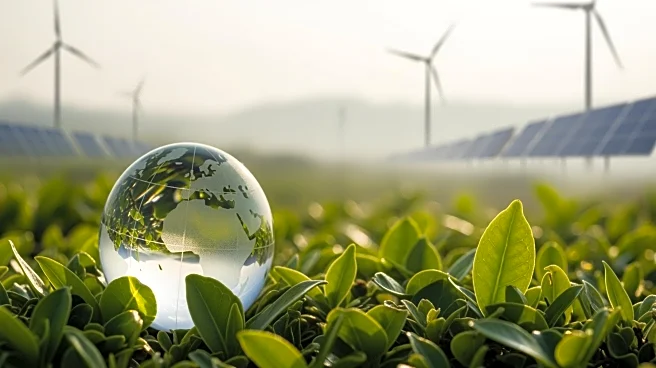
nature of the agreement, significant challenges have emerged, including the U.S. withdrawing twice and China increasing coal-powered generation. Financial commitments from wealthy nations to support poorer countries have often fallen short. However, there have been positive developments, such as a surge in renewable energy investments and a notable increase in electric vehicle sales. The Paris Agreement has catalyzed a shift towards clean energy, with renewable energy accounting for over 90% of new power generation capacity last year.
Why It's Important?
The Paris Agreement has played a crucial role in reshaping global energy policies and investments, driving a transition towards renewable energy. This shift is vital for mitigating climate change impacts, such as rising sea levels and extreme weather events. The agreement's influence extends to policy, finance, and legal frameworks, encouraging countries to adopt more sustainable practices. However, the success of these efforts hinges on political will and the ability to close the ambition gap, phase out fossil fuels, and support a just transition for affected communities. The agreement's legacy will depend on continued international cooperation and commitment to its goals.
What's Next?
The next decade is critical for the Paris Agreement's success. Countries must pursue the 'Highest Possible Ambition' scenario, aiming for net-zero CO2 emissions before 2050 and total greenhouse gas emissions by the 2060s. This requires rapid electrification of power, transport, and industry, alongside significant reductions in methane emissions. Scaling up carbon removal technologies is also essential to limit temperature overshoot. Political leaders must demonstrate courage and commitment to these goals, ensuring that the agreement's framework is used effectively to drive global climate action.
Beyond the Headlines
The Paris Agreement has set a precedent for international climate cooperation, but geopolitical tensions and economic interests pose ongoing challenges. The agreement's bottom-up approach relies on individual countries' ambition levels, making it vulnerable to political shifts. The transition to renewable energy presents opportunities for economic growth and innovation, but also requires addressing social and economic disparities. The agreement's success will depend on balancing these complex factors and maintaining momentum towards a sustainable future.