
What's Happening?
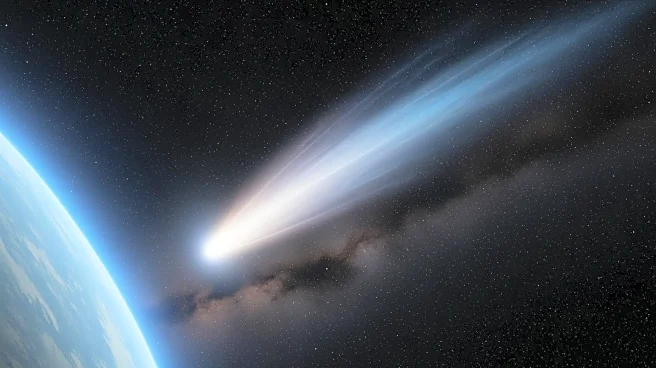
The interstellar comet 3I/ATLAS, only the third confirmed object from beyond our solar system, is currently making its way out of the solar system after its closest approach to Earth on December 19, 2025.
During this flyby, the comet was approximately 167-170 million miles away from Earth, providing a rare opportunity for scientific observation. Various space agencies, including NASA and ESA, have been collecting data using spacecraft and telescopes. Notably, the comet's hyperbolic orbit indicates it is not gravitationally bound to the Sun, confirming its interstellar origin. Observations have included radio telescopes searching for technosignatures, with no artificial signals detected, and ESA's JUICE spacecraft capturing images of the comet's activity.
Why It's Important?
The study of 3I/ATLAS offers a unique opportunity to understand the composition and behavior of interstellar objects, which can differ significantly from local solar system bodies. This research could provide insights into the formation and evolution of other planetary systems. The data collected from 3I/ATLAS, including its chemical composition and interaction with solar wind, can help scientists compare it with local comets, potentially revealing differences in the chemistry of other solar systems. The observations also serve as a rehearsal for future interstellar visitors, improving early warning systems and coordination for richer data collection.
What's Next?
As 3I/ATLAS continues its journey out of the solar system, it is expected to pass closer to Jupiter in March 2026. ESA anticipates receiving full data from the JUICE spacecraft's instruments by February 2026, which will be crucial for further analysis of the comet's composition and activity. The comet is projected to leave the solar system by the mid-2030s, marking the end of this rare scientific opportunity. The ongoing analysis of data from various space missions will continue to provide valuable insights into the nature of interstellar objects.
Beyond the Headlines
The observations of 3I/ATLAS highlight the importance of international collaboration in space exploration. The combined efforts of NASA, ESA, and other agencies demonstrate the potential for shared scientific advancements. Additionally, the study of interstellar comets like 3I/ATLAS can contribute to our understanding of the universe's diversity and the potential for life beyond our solar system. The ethical considerations of space exploration, such as the search for technosignatures, also raise questions about our place in the universe and the possibility of encountering extraterrestrial life.