
What's Happening?
Recent research led by Ben Mather at the University of Melbourne suggests that volcanic arcs have only recently become a dominant source of carbon emissions. Historically, Earth's carbon emissions were
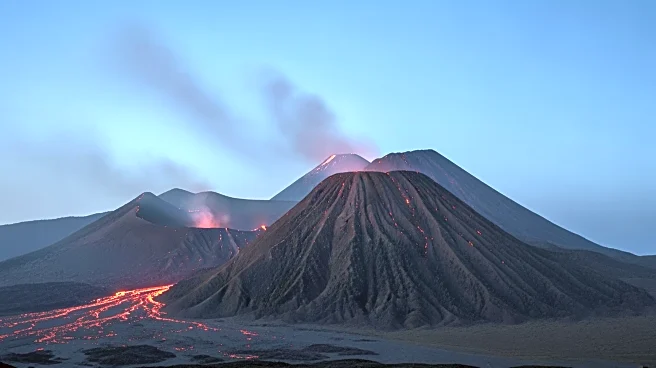
primarily released through rifting, a process where continents are torn apart, rather than volcanic arcs. This shift occurred around 100 million years ago, coinciding with the emergence of calcium carbonate-producing phytoplankton in the oceans. These plankton, upon dying, deposit calcium carbonate on the ocean floor, which is then subducted into Earth's mantle and partially released through volcanic activity. The study highlights that volcanic arcs now emit significantly more carbon due to this new reservoir of carbon on the seafloor.
Why It's Important?
Understanding the historical shifts in carbon emissions sources is crucial for climate science. The increase in carbon emissions from volcanic arcs over the past 100 million years has implications for Earth's climate history and future. This research provides insights into the natural processes that have influenced atmospheric carbon levels, which are critical for modeling climate change. The findings suggest that while volcanic arcs have increased emissions, the carbon sequestration by phytoplankton continues to play a significant role in moderating atmospheric carbon levels. This balance is essential for understanding past climate fluctuations and predicting future climate scenarios.