



What's Happening?
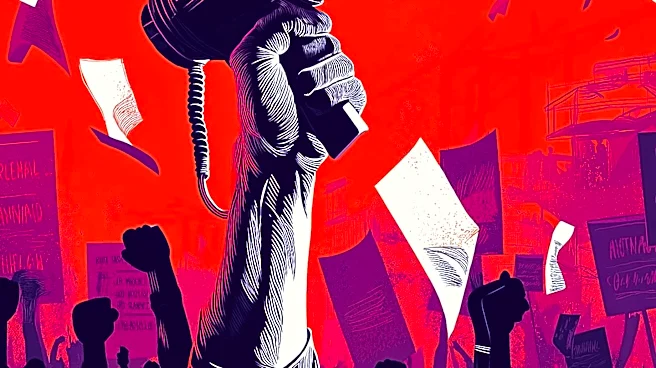
Despite unprecedented digital connectivity, American civic life is experiencing a decline in collective organization, according to Elias Winter. While individuals can quickly rally around grievances online, the ability to engage in sustained, organized
collective action has diminished. Corporations, in contrast, continue to organize effectively through associations, lobbyists, and coordinated legislative agendas. This shift is attributed to factors such as suburbanization, the rise of television, deindustrialization, and the professionalization of political campaigns. Robert Putnam and Theda Skocpol have documented this decline in civic participation, noting a move from locally rooted membership associations to professionally managed advocacy organizations. The internet, while connecting people, has not necessarily restored collective agency, often prioritizing individual expression and attention over genuine collective decision-making and obligation.
Why It's Important?
The erosion of collective organization in American civic life has profound implications for democratic governance and the distribution of power. When ordinary citizens lose the capacity for sustained collective action, their ability to influence policy and hold powerful institutions accountable diminishes. This creates an imbalance where well-organized corporate interests can more effectively shape legislative outcomes. The shift from active 'members' who govern institutions to 'donors,' 'consumers,' or 'audiences' who merely observe or finance, weakens the democratic fabric. This decline in civic infrastructure means that even with electoral victories, the underlying power dynamics may remain unchanged, making it difficult to address systemic issues like economic inequality or the impact of emerging technologies like AI on labor and ownership.
What's Next?
The current trajectory suggests that without a renewed focus on building robust civic institutions, Americans may continue to struggle with translating individual grievances into collective power. The rise of AI further complicates this, as it could weaken labor's bargaining power by substituting capital for human labor, making the distribution of ownership even more critical. The challenge for democracy will be to confront this distribution of ownership and power in an environment where civic institutions are weakened and political identities are fragmented. Rebuilding collective self-government will require fostering relationships, obligations, and sustained collective action beyond digital platforms, moving beyond mere expression to genuine organizational authority.
Beyond the Headlines
The article highlights a critical paradox: Americans are louder than ever online, yet their collective authority is waning. This suggests that the nature of civic engagement has fundamentally changed, moving from structured, accountable organizations to more ephemeral, algorithm-driven digital interactions. The deeper implication is that while individual voices are amplified, the capacity for these voices to coalesce into effective political or economic power is undermined. This raises questions about the long-term viability of popular sovereignty if the organizational substance required to exercise it continues to erode. The challenge is not just about participation, but about the quality and effectiveness of that participation in shaping a democratic future.