
What's Happening?
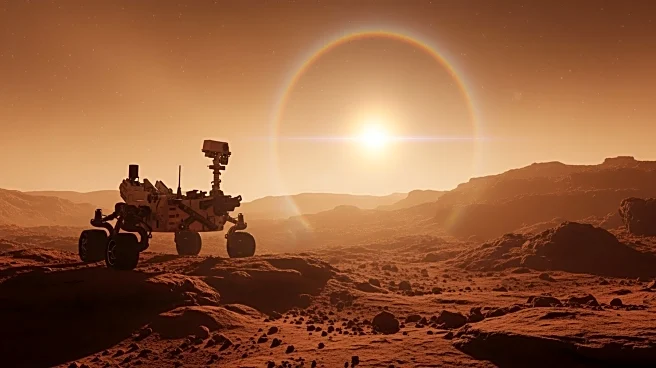
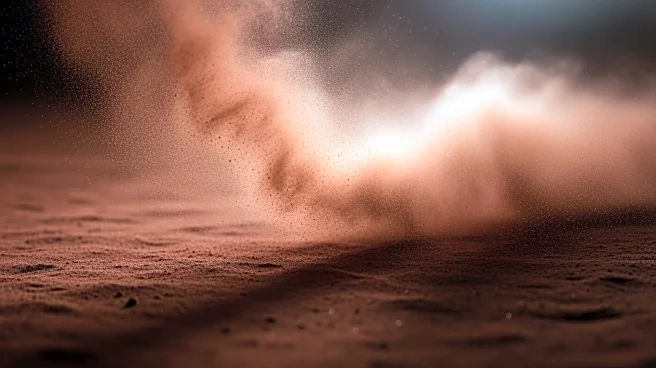
A groundbreaking study has revealed that localized dust storms on Mars play a significant role in the planet's water loss. Previously underestimated, these smaller storms can transport water vapor to higher altitudes, where it is more likely to escape
into space. The research, conducted by the Instituto de Astrofísica de Andalucía and the University of Tokyo, highlights the impact of these storms on Mars's climate evolution. The study observed an anomalous increase in water vapor during a dust storm in Martian year 37, suggesting that such events contribute significantly to the planet's long-term water loss.
Why It's Important?
Understanding the mechanisms behind Mars's water loss is crucial for reconstructing the planet's climate history and assessing its potential for past habitability. The study's findings challenge previous assumptions that only large, planet-wide dust storms were significant in water loss. By highlighting the role of smaller, regional storms, the research provides new insights into the dynamics of Mars's atmosphere. This knowledge is vital for refining climate models and planning future missions to Mars, as it affects our understanding of the planet's ability to support life and its environmental conditions over time.
What's Next?
The study opens new avenues for research into Mars's climate and atmospheric processes. Future investigations will likely focus on the frequency and impact of localized dust storms, as well as their role in the planet's water cycle. This could lead to more accurate climate models and inform the design of future Mars missions. Understanding these processes is also essential for assessing the planet's habitability and potential for past life. As space agencies plan missions to explore Mars further, monitoring dust storm activity will be crucial for predicting weather patterns and their implications for water loss.
Beyond the Headlines
The research highlights the importance of considering smaller-scale atmospheric events in understanding planetary climates. This approach could be applied to other celestial bodies, enhancing our knowledge of their environmental conditions and evolution. The study also underscores the interconnectedness of atmospheric processes and their cumulative impact on planetary environments. By expanding our understanding of these dynamics, scientists can better predict the long-term effects of climate change on Earth and other planets.