








What's Happening?
A Technion-led research team has developed a novel technique to control the direction of ultrafast electron flow within an atomic-scale scanning tunneling microscope using carefully shaped laser pulses. Published in Nature Photonics, this breakthrough
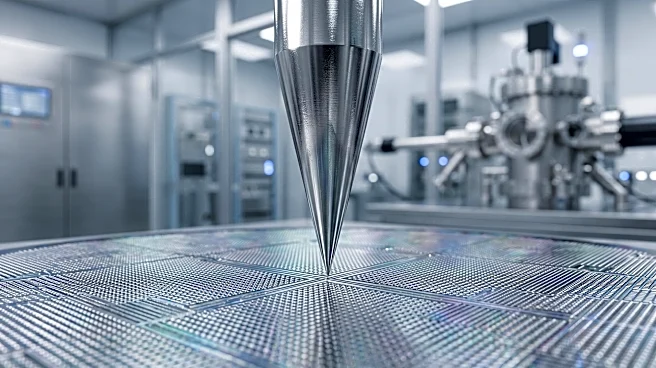
allows researchers to observe electron movement at the atomic level and capture its motion on incredibly short timescales. The team directed infrared laser pulses, each containing two colors of light, into the gap between the microscope's sharp needle tip and a sample. By precisely adjusting the relative timing of these light colors, they could steer electrons from the needle tip to the sample or in the opposite direction. This method enabled the reconstruction of current bursts lasting a mere 860 attoseconds (one billionth of a billionth of a second). The microscope maintained a high spatial resolution of about two nanometers and could detect surface height changes smaller than an angstrom, even at room temperature and in air.
Why It's Important?
This advancement has significant implications for the U.S. technology and scientific research sectors. The ability to precisely control and observe electron flow at atomic scales opens new frontiers in materials science, quantum computing, and electronics. It could lead to the development of next-generation electronic devices where light waves control currents at speeds and scales far beyond current capabilities, potentially revolutionizing computing power and energy efficiency. For researchers, this technique provides an unprecedented tool to study fundamental physical processes, such as electron transport in novel materials, which is crucial for designing advanced semiconductors and quantum technologies. The U.S. stands to gain a competitive edge in these high-tech fields by leveraging such precise control over matter at its most fundamental level, fostering innovation in areas from advanced manufacturing to high-performance computing.
What's Next?
The immediate next steps for the researchers involve further exploring how electrons move at specific locations within materials as this motion unfolds. While the current study establishes precise control of electron flow in the microscope's nanoscale gap, the long-term goal is to translate this fundamental understanding into practical applications. This includes investigating how these light-controlled currents could inform the design of future electronics. Significant research will be required to integrate such specialized laser systems into more conventional electronic architectures. The team will continue to refine the technique, potentially aiming for even finer control and observation capabilities. This foundational research is expected to pave the way for future technological breakthroughs, though commercial applications are likely several years away.
Beyond the Headlines
The ability to sculpt light to steer electron flow at attosecond timescales touches upon the very essence of how matter and energy interact. This goes beyond merely making faster computers; it delves into the fundamental limits of information processing and energy transfer. Ethically, such precise control over quantum phenomena could eventually lead to technologies with unforeseen capabilities, prompting discussions about their responsible development and deployment. Culturally, it reinforces the idea of scientific progress as a continuous push against the boundaries of the observable and controllable, inspiring new generations of scientists and engineers. This research also highlights the increasing sophistication of experimental physics, where complex laser systems and microscopy techniques are combined to probe the quantum world, revealing insights that could fundamentally alter our understanding of materials and energy.