








What's Happening?
Astronomers have identified a third galaxy, NGC 1052-DF9, that appears to lack a significant dark matter halo, joining two previously discovered galaxies, DF2 and DF4. These galaxies are aligned in a straight line in the NGC 1052 field, suggesting they
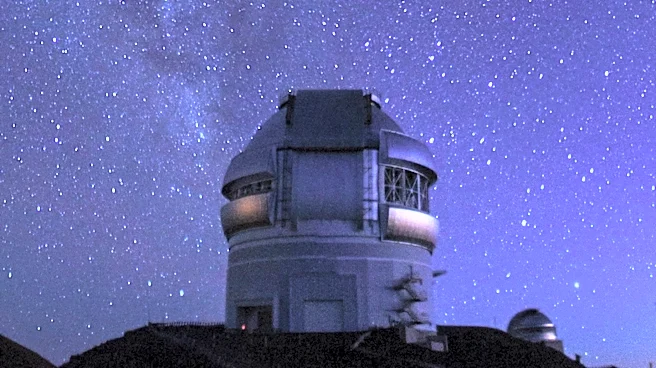
may have originated from a high-speed collision between two gas-rich galaxies. This collision likely separated ordinary matter from dark matter, leading to the formation of galaxies primarily composed of normal matter. The discovery was made using the W. M. Keck Observatory, which measured the internal motions of DF9's stars, revealing a velocity dispersion consistent with a lack of dark matter. This finding supports the hypothesis that these galaxies were formed in a violent event that stripped them of their dark matter.
Why It's Important?
The discovery of galaxies without dark matter challenges existing theories about galaxy formation and the role of dark matter. It provides evidence that dark matter exists as a substance rather than a gravitational anomaly. This finding could lead to a better understanding of dark matter's properties and its role in the universe. The alignment of these galaxies suggests a specific origin, potentially offering a new method to study dark matter through the remnants of such cosmic collisions. This research could have significant implications for astrophysics, potentially reshaping our understanding of galaxy formation and the distribution of dark matter in the universe.
What's Next?
Future research will focus on identifying additional galaxies along the same trail to confirm the collision hypothesis. Astronomers aim to detect gas remnants from the collision, which would serve as 'smoking gun' evidence of the event. This could provide a clearer picture of how such galaxies form and further validate the existence of dark matter as a physical substance. Continued observations and simulations will be crucial in testing these theories and expanding our knowledge of cosmic structures.