
What's Happening?
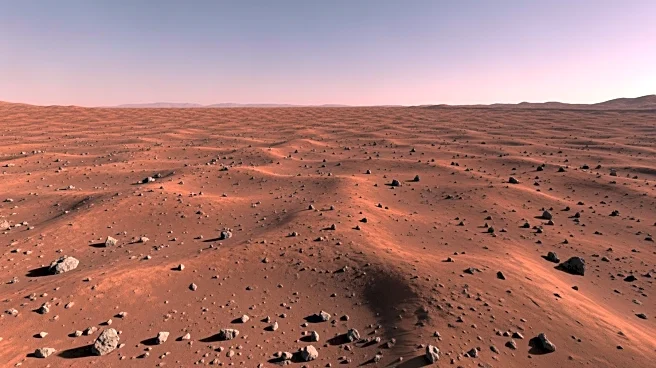
Scientists have pinpointed Amazonis Planitia on Mars as a promising site for future human landings, a significant step in the long-term goal of colonizing the Red Planet. This discovery, made using high-resolution
imagery from NASA's HiRISE camera, highlights the region's balance of sunlight access and subsurface ice availability. The study, published in the Journal of Geophysical Research: Planets, emphasizes the strategic importance of accessible water ice, which is crucial for life support systems and in-situ resource utilization. Researchers, including Erica Luzzi and Giacomo Nodjoumi, have identified this 'Goldilocks zone' as optimal for solar energy collection and maintaining temperatures that preserve subsurface water ice. This makes the region suitable for long-term missions that cannot rely on regular resupply from Earth.
Why It's Important?
The identification of Amazonis Planitia as a viable landing site is crucial for future Mars missions, as it offers a potential source of water ice, which is essential for sustaining human life and reducing mission costs. The ability to extract water from the ground would enable astronauts to produce hydrogen-based fuel, oxygen, and support agricultural systems, aligning with NASA's Artemis-to-Mars vision. This discovery also aids in mission planning, allowing engineers to design habitat layouts and energy infrastructure based on known features of the site. The involvement of international agencies, such as the Italian Space Agency, underscores the global interest in Mars exploration and the potential for multi-national missions.
What's Next?
The next steps involve sending robotic missions to Amazonis Planitia to conduct direct sampling and geological analysis to confirm the presence and quality of subsurface ice. These missions will assess terrain stability and test in-situ resource technologies, paving the way for future crewed missions. The site's relatively flat, low-elevation area reduces atmospheric entry challenges, facilitating safer landings. As exploration technologies advance, the timeline for human presence on Mars could accelerate, with Amazonis Planitia potentially becoming the first human outpost on another planet.