
What's Happening?
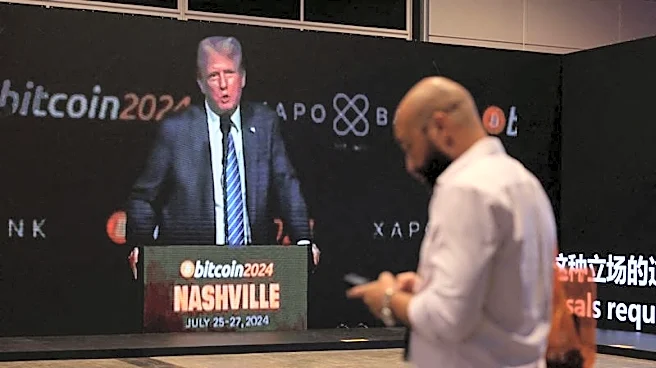
World Liberty Financial, a cryptocurrency company co-founded by President Trump and his sons Don Jr. and Eric, has received preliminary approval from the Office of the Comptroller of the Currency (OCC)
to operate its subsidiary, World Liberty Financial Trust, as a national trust bank. This approval, granted on August 14, marks a significant development for the company, which was launched in 2024. President Trump, holding the title of 'Co-Founder Emeritus,' and his sons, listed as 'co-founders,' collectively own a 38% stake in World Liberty Financial. This ownership has reportedly increased President Trump's net worth by over $2 billion since taking office. The company plans to mint and safeguard its own stablecoin, USD1, a cryptocurrency pegged to the U.S. dollar. Senator Elizabeth Warren has criticized this development, calling it 'the most brazen act of self-dealing our financial system has ever seen.' The OCC, however, maintains that its chartering process is 'transparent, apolitical and nonpartisan.'
Why It's Important?
The preliminary approval for World Liberty Financial to operate as a national trust bank raises significant concerns about potential conflicts of interest and the politicization of the U.S. financial system. With President Trump and his family holding a substantial stake in the company, there are worries that a federal regulator, appointed by President Trump, will now oversee his own bank. This situation could lead to market distortions, moral hazard, and weakened regulatory independence, as the company might receive favorable treatment from financial regulators and law enforcement agencies. Experts like Chastity Murphy, a former senior adviser at the Treasury Department, suggest that such an entanglement could 'quietly reshape the entire market' by steering capital flows and concentrating risk. The company's ability to issue and hold its own stablecoin, USD1, and profit from interest on deposits, further amplifies these concerns, as it could create a state-favored enterprise by default, impacting competition and market neutrality.
What's Next?
World Liberty Financial still needs to satisfy certain conditions before receiving final approval to operate as a trust bank, with no clear timeline for this to occur. The charter approval process is expected to become a subject of congressional oversight, particularly if Democrats gain control of one or both chambers of Congress in the upcoming November elections. Such oversight could determine the long-term viability and regulatory framework for a presidentially-connected bank in the U.S. financial landscape. The company's existing partnerships and investments, including a $500 million investment from a UAE sovereign wealth fund and a $2 billion investment from MGX into USD1, will likely face increased scrutiny. The potential for the company to be treated as 'too-big-to-fail' from its inception, leading to increased risk-taking, is also a significant concern that will need to be addressed by regulators and policymakers.
Beyond the Headlines
The establishment of World Liberty Financial as a presidentially-connected crypto bank extends beyond traditional conflict of interest issues, potentially ushering in a new era of politicized finance. This development raises questions about how a president can combine control of private money with public power to advance private policy agendas or political interests. The ability for President Trump to 'print his own money,' issue coins, and direct funding through a private financial network could create an infrastructure to reward allies and punish adversaries, centralizing power without transparency or political accountability. The involvement of foreign entities, such as the UAE, in significant investments in World Liberty Financial and its stablecoin, USD1, also introduces complex foreign policy implications. The potential for regulatory favoritism and the creation of a 'state-favored' stablecoin could fundamentally alter market dynamics, leading to a financial system where political connections, rather than market efficiency, drive success and influence.