





What's Happening?
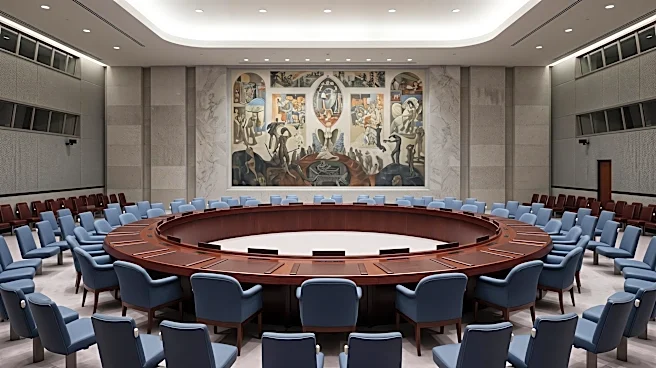
Sudan's Permanent Representative to the United Nations, Ambassador Al-Harith Idriss, has voiced strong opposition to the expansion of an arms embargo across Sudan. Addressing the UN Security Council, Ambassador Idriss stated that such an embargo conflicts
with Article 51 of the UN Charter, which upholds the inherent right of member states to self-defense. He emphasized that the Sudanese Armed Forces and integrated forces are engaged in defending the nation and repelling aggression, asserting their right to possess, produce, and acquire conventional weapons necessary for sovereignty and territorial protection. Ambassador Idriss highlighted that ongoing wartime conditions and security fragility prevent the state from fully controlling weapon movements and proliferation, especially given the presence of numerous armed groups and mercenaries. He also noted the international community's failure to support the integration and disarmament of armed groups following the 2020 Juba Peace Agreement, citing the Rapid Support Forces (RSF) militia's refusal to integrate. The Ambassador warned that the proposed resolution would empower non-state armed groups, weaken the armed forces' constitutional role, and fuel illicit arms trade across Sudan's borders and into neighboring countries. He further pointed out that the continuous influx of weapons and drone attacks from neighboring territories suggest external support for the RSF militia.
Why It's Important?
This stance by Sudan's UN Representative is crucial as it directly challenges international efforts to control arms flow in a conflict-ridden region, potentially impacting regional stability and humanitarian efforts. By invoking Article 51 of the UN Charter, Sudan is asserting a fundamental right to self-defense, which, if acknowledged, could alter the dynamics of international intervention and arms control policies. The argument that an arms embargo strengthens non-state actors while weakening legitimate state forces presents a complex dilemma for the international community. If the embargo is perceived to disproportionately affect the state's ability to maintain order, it could inadvertently prolong conflicts and exacerbate humanitarian crises. Furthermore, the accusation of external actors supporting the RSF militia through weapon influx and drone attacks raises concerns about proxy conflicts and the broader geopolitical implications for the Horn of Africa. The debate over the arms embargo highlights the tension between national sovereignty and international efforts to prevent violence and protect civilians, with potential long-term consequences for Sudan's internal security and its relationships with neighboring countries and international bodies.
What's Next?
The UN Security Council will likely continue deliberations on the arms embargo, weighing Sudan's arguments against the broader objectives of peace and security. Ambassador Idriss's call for a 'purely technical renewal of Resolution 1591' suggests a desire to limit the scope of any embargo, focusing on specific areas rather than a nationwide ban. The international community will need to assess the validity of Sudan's claims regarding the empowerment of armed groups and the impact on the state's self-defense capabilities. This could lead to a re-evaluation of the embargo's terms, potentially introducing more nuanced restrictions or increased support for state-building efforts. Stakeholders, including regional organizations and humanitarian agencies, will closely monitor these discussions, as the outcome will directly influence the security landscape and the effectiveness of aid operations in Sudan. The ongoing conflict and the presence of armed groups will continue to pose significant challenges, regardless of the embargo's final form, necessitating sustained diplomatic engagement and a comprehensive approach to peacebuilding.
Beyond the Headlines
The debate surrounding the arms embargo in Sudan extends beyond immediate security concerns, touching upon deeper issues of international law, state sovereignty, and the ethics of intervention. The argument that an arms embargo can inadvertently weaken a state's capacity to protect its citizens and territory raises fundamental questions about the efficacy and unintended consequences of such measures. It also highlights the complex interplay between internal conflicts and external influences, where the flow of arms can be manipulated by various actors with differing agendas. The situation in Sudan underscores the challenge of balancing the principle of non-interference with the responsibility to protect populations from violence. Furthermore, the long-term implications for Sudan's development and stability are significant; a weakened state, unable to assert control, risks prolonged instability, economic decline, and a perpetuation of humanitarian crises. This case could set a precedent for how the international community approaches similar conflicts, influencing future policies on arms control and state support in fragile regions.