



What's Happening?
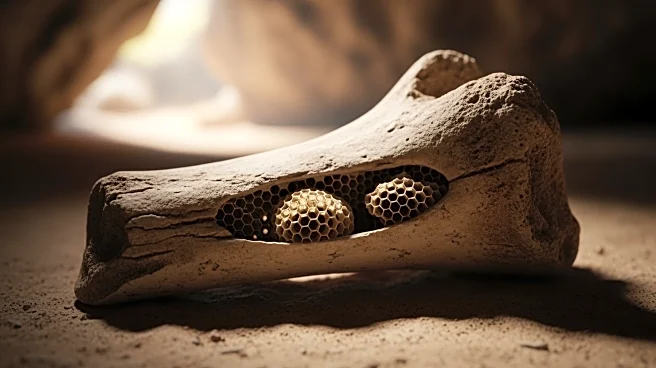
Paleontologists have discovered that ancient solitary bees once nested in the tooth holes of a fossilized jawbone found in a cave on the Caribbean island of Hispaniola. The jawbone, believed to belong to a capybara-like rodent, was likely transported
to the cave by an owl. Over time, the jawbone's teeth loosened, creating cavities that were used by a newly described species of burrowing bee, Osnidum almontei, for nesting. This finding, published in Royal Society Open Science, marks the first time ancient bees have been observed using pre-existing cavities in fossils for nesting. The research team, led by Lazaro Viñola Lopez, used micro-computed tomography scans to reveal multi-generational use of these cavities, indicating a high degree of nest fidelity.
Why It's Important?
This discovery provides new insights into the nesting behavior and ecological adaptations of ancient bees. The opportunistic use of bone cavities by Osnidum almontei suggests a high level of adaptability, which could inform our understanding of bee evolution and their role in ancient ecosystems. The findings also highlight the potential for trace fossils to reveal behavioral patterns of extinct species, offering a unique perspective on past biodiversity and ecological interactions. This research contributes to the broader understanding of how ancient species adapted to their environments, which is crucial for reconstructing historical ecosystems.