






What's Happening?
Morocco's Ministry of Foreign Affairs, African Cooperation and Moroccans Abroad issued a statement emphasizing its commitment to its partnership with Spain while cautioning against the use of Morocco as a target in Spanish domestic political battles.
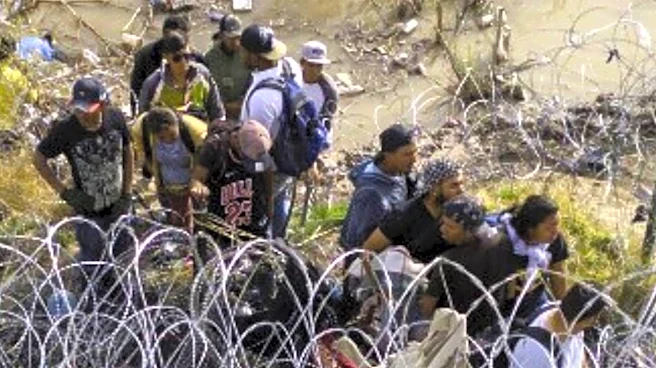
The ministry reaffirmed that the foundation of their bilateral relations, established by the April 7, 2022 joint declaration between King Mohammed VI and Spanish Prime Minister Pedro Sánchez, is based on mutual respect, trust, dialogue, and a shared commitment to a mutually beneficial partnership. This approach has allowed both nations to strengthen common interests and manage differences through dialogue. The statement highlighted the success of their cooperation in economic and security sectors, noting Spain as Morocco's leading economic partner and Morocco as Spain's second-largest trading partner outside the European Union. It also underscored effective security cooperation in dismantling terrorist and criminal networks. The ministry questioned ongoing criticism directed at Morocco regarding irregular migrants and unaccompanied minors, suggesting that answers should be sought from relevant Spanish actors.
Why It's Important?
This development is important as it highlights the delicate balance in international relations, particularly when domestic political agendas intersect with foreign policy. Morocco's firm stance against being instrumentalized in Spanish internal politics underscores the potential for such actions to destabilize established diplomatic and economic ties. The partnership between Morocco and Spain is significant, with Spain being Morocco's primary economic partner and Morocco holding a crucial position as Spain's second-largest non-EU trading partner. Disruptions to this relationship could have considerable economic implications for both countries, affecting trade flows, investment, and regional stability. Furthermore, the emphasis on security cooperation, particularly in combating terrorism and criminal networks, indicates the broader regional security implications. Any weakening of this cooperation due to political tensions could impact efforts to maintain stability and security across the Mediterranean, potentially affecting U.S. interests in regional counter-terrorism efforts and economic stability.
What's Next?
Morocco's statement indicates a clear desire to maintain and protect its partnership with Spain, suggesting that future interactions will likely involve continued diplomatic efforts to reinforce the principles of mutual respect and non-interference in domestic affairs. The Moroccan Foreign Ministry's call for Spanish actors to address questions regarding irregular migrants and unaccompanied minors internally suggests that these issues will remain points of discussion, requiring resolution from the Spanish side to prevent further strain on relations. The statement also implies that Morocco will continue to resist any attempts to be used as a 'scapegoat' in Spanish pre-electoral campaigns. The trajectory of the relationship will depend on how Spanish political and media circles respond to Morocco's concerns and whether they adjust their rhetoric to avoid instrumentalizing the North African nation for internal political gain. Continued dialogue and adherence to the 2022 joint declaration will be crucial for preserving the stability and benefits of this bilateral partnership.
Beyond the Headlines
Beyond the immediate diplomatic exchange, this situation reflects a broader challenge in international relations where domestic political pressures can impinge upon foreign policy. The 'instrumentalization' of foreign nations for internal political gain, as described by Morocco, can erode trust and undermine long-term strategic partnerships. This dynamic can lead to a cycle of mistrust and tension, making it harder to address shared challenges such as migration, security, and economic development. The ethical dimension of using another sovereign nation as a political football raises questions about diplomatic integrity and the responsible conduct of political discourse. For the U.S., such regional instability could complicate its strategic objectives in North Africa and Southern Europe, including counter-terrorism efforts and promoting economic stability. The incident also highlights the importance of clear communication and adherence to agreed-upon diplomatic frameworks to prevent misunderstandings and maintain constructive international relations, especially between geographically proximate and economically interdependent nations.