

What's Happening?
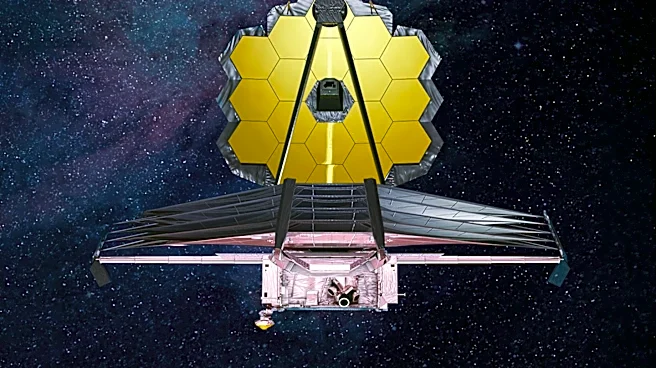
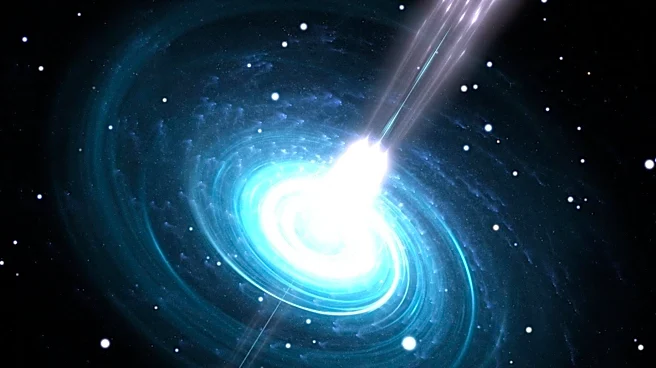
Astronomers utilizing NASA’s James Webb Space Telescope have successfully identified the host galaxy of the most distant fast radio burst (FRB) ever observed, designated FRB 20240304B. This millisecond-long flash of radio emission occurred approximately
3 billion years after the Big Bang, making it significantly older than most previously detected FRBs. The MeerTRAP team initially detected the burst using the MeerKAT telescope, but ground-based telescopes could not identify its host galaxy due to its extreme distance. Webb’s Near-Infrared Camera (NIRCam) located the host galaxy, and its Near-Infrared Spectrograph (NIRSpec) precisely measured its redshift at 2.148. Contrary to expectations, the host galaxy is a small dwarf galaxy, about 1,000 times less massive than typical FRB host galaxies, though it is actively forming stars. This discovery challenges existing theories about FRB origins, particularly those involving the merger of neutron stars.
Why It's Important?
This discovery by the Webb Telescope is crucial for understanding the enigmatic origins of fast radio bursts. The finding that FRB 20240304B originated in a young, actively star-forming dwarf galaxy at 'cosmic noon' strongly supports the theory that FRBs are produced by young, highly magnetic neutron stars, known as magnetars, possibly through mechanisms like starquakes. This contradicts the alternative theory that FRBs result from the merger of two neutron stars, a process expected to take billions of years and thus be associated with older galaxies. By pinpointing the host galaxy and its characteristics, scientists gain critical evidence to refine models of FRB generation. Furthermore, FRBs act as 'cosmic flashlights,' illuminating the otherwise invisible matter and structures along their path, allowing astronomers to trace the 'cosmic web' and study intergalactic medium properties, including previously unknown galaxy clusters.
What's Next?
The team anticipates discovering more distant FRBs as radio telescope facilities like MeerKAT continue to improve and new instruments come online. The MeerKAT telescope is expected to detect and localize several FRBs per year at redshifts greater than 1.0, providing a growing sample of these distant events. The James Webb Space Telescope will remain essential for characterizing the host galaxies of these newly discovered distant FRBs, providing crucial data on their age, mass, and star-formation rates. Future observations will aim to confirm the prevalence of dwarf, star-forming galaxies as hosts for distant FRBs, further solidifying the magnetar origin theory. This ongoing research will continue to use FRBs as probes to map the distribution of matter in the universe and study the cosmic web in unprecedented detail.
Beyond the Headlines
The identification of the farthest FRB and its host galaxy represents a significant step in unraveling one of the universe's most perplexing mysteries. Beyond confirming the likely origin of FRBs, this research highlights the extraordinary capabilities of the James Webb Space Telescope to push the boundaries of astronomical observation, detecting faint objects at extreme distances. The use of FRBs as cosmic probes offers a unique method to study the intergalactic medium, providing insights into the distribution of baryonic matter that is otherwise difficult to observe. This could help resolve the 'missing baryon problem' in cosmology. The discovery also underscores the dynamic and violent nature of the early universe, where intense star formation could rapidly produce the conditions necessary for such powerful bursts. This interdisciplinary approach, combining radio astronomy with infrared space-based observations, exemplifies the future of astrophysical research, where multiple instruments work in concert to unlock cosmic secrets.