






What's Happening?
Researchers at IIT Bhubaneswar have developed a deep learning-based model that can predict cloudburst events in the Himalayan regions of Himachal Pradesh and Uttarakhand up to 72 hours in advance. This model, detailed in a study published in the journal
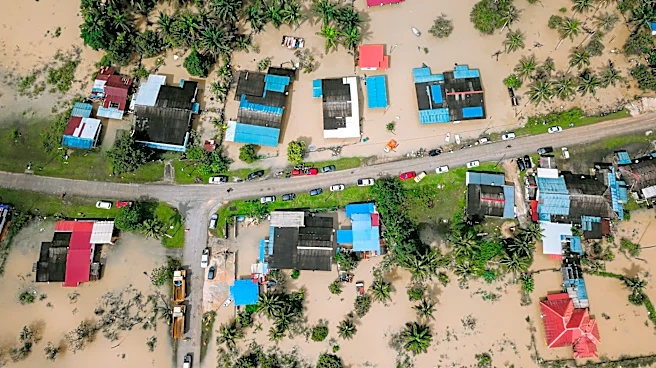
Neural Computing and Applications, aims to improve disaster preparedness by providing more accurate forecasts than traditional weather models. The study analyzed cloudburst and extreme rainfall events that occurred in August 2023, which resulted in over 140 deaths and widespread destruction. The research team, including Sandeep Pattnaik, Hemant Kumar, Dhananjay Trivedi, Omveer Sharma, and Niladri Bihari Puhan, developed a 'dual-encoder cross-attention fusion transformer' model that integrates district- and state-level weather patterns for enhanced forecasting accuracy. The model demonstrated a mean absolute error of less than 9 mm, outperforming conventional Weather Research and Forecasting (WRF) models.
Why It's Important?
The development of this AI model is significant as it addresses the limitations of traditional weather prediction models, particularly in mountainous terrains where short-duration heavy rainfall events are challenging to predict. By providing more accurate forecasts, the model can help authorities issue timely warnings, potentially saving lives and reducing the impact of natural disasters in ecologically sensitive Himalayan regions. The ability to predict cloudbursts with greater accuracy is crucial as these regions are increasingly vulnerable to extreme weather events due to climate change. The model's success in capturing rainfall variations in key districts like Mandi, Dehradun, Haridwar, and Pauri Garhwal highlights its potential to enhance disaster preparedness and mitigation strategies.
What's Next?
The implementation of this AI model could lead to more reliable early warning systems in the Himalayan regions, allowing for better disaster management and response strategies. Authorities may consider integrating this model into existing weather forecasting frameworks to improve the accuracy of predictions and enhance public safety measures. Further research and development could refine the model's capabilities and expand its application to other regions prone to extreme weather events. Collaboration with governmental and environmental agencies could facilitate the deployment of this technology, ensuring that communities are better prepared for future climate-related challenges.