




What's Happening?
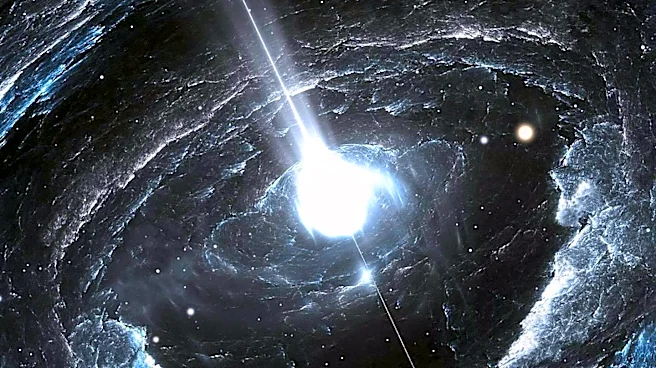
New research indicates that Cherenkov radiation from the quantum vacuum, a strong-field quantum electrodynamics (QED) phenomenon, provides a distinct pair-creation channel in pulsar magnetospheres. This mechanism helps explain the existence of radio pulsars
within and below the 'death valley' in the P-Ṗ diagram, a region where standard pair-cascade models based on curvature radiation (CR) and resonant inverse Compton scattering (RICS) predict radio emission should cease. The quantum vacuum Cherenkov (QC) mechanism ensures rapid conversion into electron-positron pairs, remaining viable even when classical mechanisms are suppressed. This leads to additional 'death lines' that extend beyond those predicted by CR and RICS, thereby enlarging the parameter space for radio-emitting neutron stars. This finding offers a physical basis for coherent radio emission from long-period neutron stars, such as PSR J0250+5854 and PSR J0901-4046, which challenge previous theoretical models.
Why It's Important?
This development is significant for astrophysics and fundamental physics, as it provides a new framework for understanding pulsar behavior and offers an observable window for testing non-linear QED. The ability of the QC mechanism to explain the existence of ultra-long-period pulsars, which were previously anomalies, strengthens our understanding of extreme astrophysical environments. It suggests that strong-field QED effects, typically beyond terrestrial laboratory capabilities, play a crucial role in these cosmic phenomena. The research also highlights the potential for next-generation radio facilities, such as the Square Kilometre Array, to probe these non-linear QED effects. By extending the viable parameter space for radio-emitting neutron stars, this work could lead to a re-evaluation of pulsar population statistics and evolution models, impacting our broader understanding of neutron star physics and the universe's most extreme magnetic fields.
What's Next?
Future research will likely focus on further refining the quantum vacuum Cherenkov emission model and integrating it into broader pulsar evolution theories. Observational efforts using advanced radio telescopes like the Square Kilometre Array are expected to search for the distinct gamma-ray signatures predicted by the QC mechanism, particularly in the hard X-ray to soft gamma-ray band. These observations could provide direct experimental verification of the model's predictions. Additionally, theoretical work may explore the implications of this mechanism for other high-energy astrophysical phenomena and its potential connections to other strong-field QED processes. The findings could also stimulate further experimental investigations into strong-field QED effects in laboratory settings, pushing the boundaries of high-intensity laser physics.
Beyond the Headlines
The discovery of quantum vacuum Cherenkov emission's role in pulsar magnetospheres delves into the fundamental nature of vacuum itself under extreme conditions. It underscores that what we perceive as empty space is, in fact, a dynamic medium capable of complex quantum interactions when subjected to immense electromagnetic fields. This has profound implications for our understanding of quantum field theory and the limits of physics. The ability to test non-linear QED in astrophysical settings provides a unique 'natural laboratory' that complements terrestrial experiments, pushing the boundaries of our knowledge about the universe's most extreme environments. It also highlights the interconnectedness of seemingly disparate fields, from theoretical quantum mechanics to observational astronomy, in unraveling the universe's deepest mysteries.