
What's Happening?
NASA has released a new image of the interstellar comet 3I/ATLAS, captured by the Hubble Space Telescope on November 30, 2025. The image, taken when the comet was approximately 286 million kilometers from
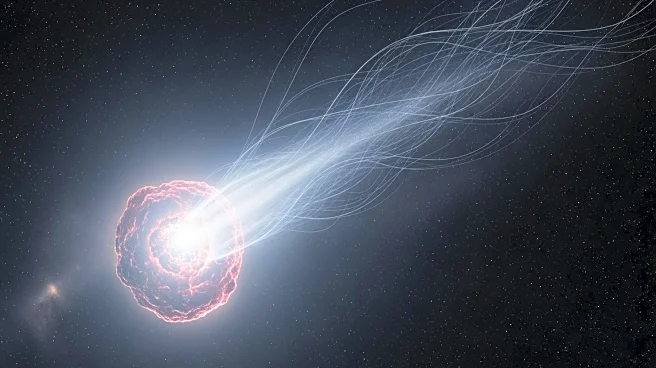
Earth, shows the comet's nucleus and coma with background stars appearing as streaks due to Hubble's tracking. This comet, discovered on July 1, 2025, by the ATLAS survey telescope in Chile, is only the third known interstellar object to pass through our solar system. The comet's path is hyperbolic, indicating it is not bound by the Sun's gravity and will not return once it leaves. Hubble's observations reveal a bright central coma surrounded by a teardrop-shaped halo and a sunward-pointing 'anti-tail,' a streak of dust and gas extending toward the Sun. This phenomenon is attributed to perspective and the distribution of dust grains along the comet's orbit.
Why It's Important?
The observation of 3I/ATLAS is significant as it provides a rare opportunity to study an interstellar object, offering insights into the composition and behavior of comets from other star systems. The data collected by Hubble and other observatories can enhance our understanding of the chemical complexity and activity of such objects, which are considered a 'gold mine' for scientific research. The comet's unique features, such as the 'anti-tail,' challenge existing models and prompt further investigation into the forces and processes at play. This research could have broader implications for our understanding of the formation and evolution of planetary systems, as well as the potential for interstellar objects to deliver organic materials across the galaxy.
What's Next?
Astronomers will continue to monitor 3I/ATLAS as it approaches its closest pass by Earth on December 19, 2025, and later its close encounter with Jupiter on March 16, 2026. The comet is expected to remain observable with small telescopes until spring 2026, after which it will fade from view as it moves beyond the orbits of Saturn and Uranus. ESA's Juice spacecraft, which observed the comet in early November, will downlink its full dataset in February 2026, providing high-resolution images and spectra that will further illuminate the comet's composition and interaction with the solar wind. These observations will contribute to a comprehensive understanding of 3I/ATLAS and its place in the broader context of interstellar objects.
Beyond the Headlines
The study of 3I/ATLAS also raises questions about the potential for interstellar objects to influence planetary systems. Some scientists speculate that such comets could deliver prebiotic chemistry or even life to planets, although current data support the view that 3I/ATLAS is a natural comet. The ongoing debate highlights the need for continued observation and analysis to distinguish between natural and potentially artificial origins of interstellar objects. The findings from 3I/ATLAS will serve as a benchmark for future studies of similar objects, enhancing our understanding of the dynamics and composition of bodies that traverse the galaxy.