





What's Happening?
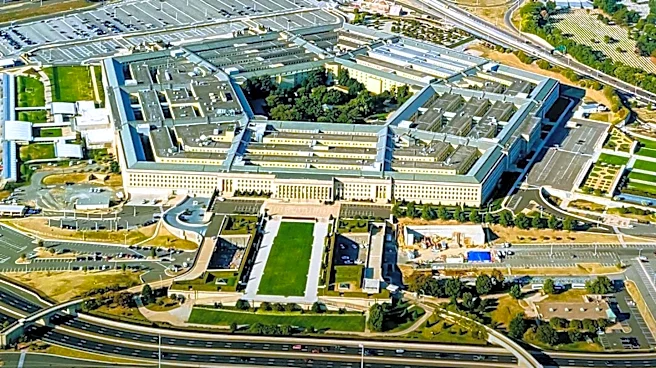
A U.S. Court of Appeals for the District of Columbia Circuit panel has upheld the Department of Defense's decision to designate Anthropic, an AI company, as a 'supply chain risk,' effectively excluding its AI model, Claude, from Pentagon procurement.
This ruling maintains the Department of Defense's stance that Claude could be unreliable for military operations due to usage restrictions and unresolved contractual disputes. Anthropic had challenged the designation, citing violations of the First and Fifth Amendments, but the court rejected these arguments. The Federal Acquisition Supply Chain Security Act, typically used to exclude products linked to foreign adversaries, was the basis for this unprecedented application to a U.S. AI company. While a federal district court in California had partially invalidated this designation in August, allowing other government agencies to continue business with Anthropic, the appellate court's decision creates a divided situation where the AI cannot be used within the Department of Defense. Anthropic claims this designation has already resulted in billions of dollars in losses.
Why It's Important?
This ruling sets a significant precedent for the burgeoning AI industry and its interaction with national security. It highlights a fundamental conflict between corporate ethical policies and governmental defense requirements. Anthropic's self-imposed usage restrictions, designed to prevent its AI from being used for mass surveillance or autonomous weapons, were viewed by the military as a 'lack of reliability.' This suggests that AI companies prioritizing safety and ethical use may face exclusion from lucrative government contracts, potentially incentivizing companies to relax such restrictions to secure defense procurement. This could lead to a divergence in AI safety standards, with different terms of service for military and security agencies compared to other customers. The decision also casts a shadow over Anthropic's IPO plans, as exclusion from one of the world's largest procurement entities could impact its growth prospects and valuation, forcing investors to weigh the lost defense market against the value of trust gained through ethical commitments.
What's Next?
Anthropic may consider appealing the ruling to the Supreme Court or seeking a settlement with the Department of Defense. The outcome of this case will likely influence how other AI companies structure their ethical guidelines and engage with government contracts, particularly in the defense sector. Companies aiming for large government contracts may be compelled to develop distinct terms of service for military and security agencies to avoid being labeled a 'supply chain risk.' This could lead to a fragmented landscape of AI safety standards, with implications for the broader adoption and regulation of AI technologies. The ongoing discussions between the U.S. and China regarding AI accident communication channels, and the U.S. government's screening of AI model provision to allies, further underscore the increasing geopolitical and strategic importance of AI, suggesting that future developments in AI governance will be heavily influenced by national security considerations.
Beyond the Headlines
The ruling delves into the deeper implications of AI governance, particularly the question of 'who governs AI, and how.' It underscores that ethical policies are no longer mere public relations statements but critical management decisions that directly influence revenue and market access. The case reveals a tension between the desire for AI safety and the demands of national security, where a company's commitment to ethical usage can be perceived as a vulnerability. This could trigger a long-term shift in the AI industry, potentially creating a divide between companies that prioritize ethical AI development and those that prioritize securing government contracts. The decision also raises questions about the role of independent oversight bodies and shareholder influence in shaping AI policies, especially as AI companies go public. The broader implication is that the development and deployment of AI will increasingly be shaped not just by technological advancements, but by complex legal, ethical, and geopolitical considerations, making the 'boundary between the training environment and the outside world' a critical area of concern.