



What's Happening?
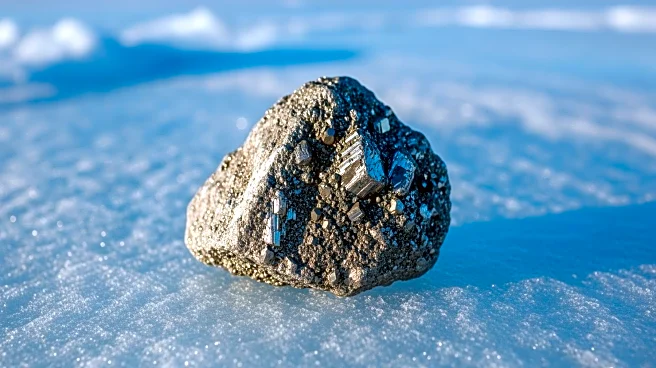
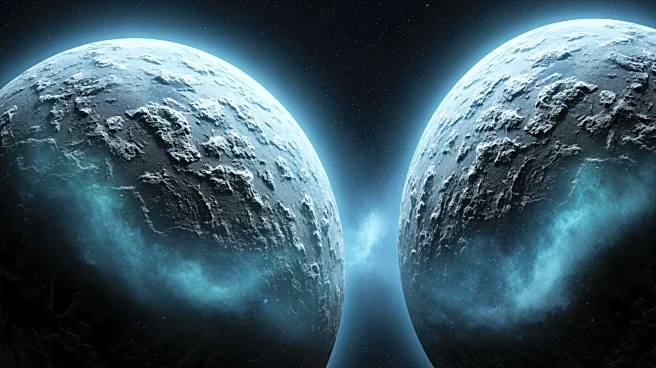
A study by researchers from the University of Zurich and the NCCR PlanetS proposes that Uranus and Neptune might be more rocky than icy, challenging their traditional classification as ice giants. The research, published in Astronomy & Astrophysics, uses
a novel simulation process to explore the planets' interior compositions. The study suggests that both planets could be either water-rich or rock-rich, with current data unable to definitively categorize them. The research also provides new insights into the complex magnetic fields of Uranus and Neptune, which differ significantly from Earth's. The findings underscore the need for dedicated missions to these planets to better understand their true nature.
Why It's Important?
This research could redefine our understanding of the outer planets in our solar system, impacting theories about planetary formation and evolution. The potential reclassification of Uranus and Neptune as rock giants rather than ice giants could influence future space missions and the study of exoplanets with similar characteristics. Understanding the magnetic fields and internal compositions of these planets could also provide insights into the dynamics of planetary atmospheres and magnetic fields, which are crucial for understanding planetary habitability and the potential for life.
What's Next?
The study highlights the need for new space missions to Uranus and Neptune to gather more detailed data on their compositions and magnetic fields. Such missions could provide critical information to resolve current uncertainties and refine models of planetary interiors. The research may also inspire further studies into the behavior of materials under extreme conditions, which could have broader implications for materials science and planetary exploration.