




What's Happening?
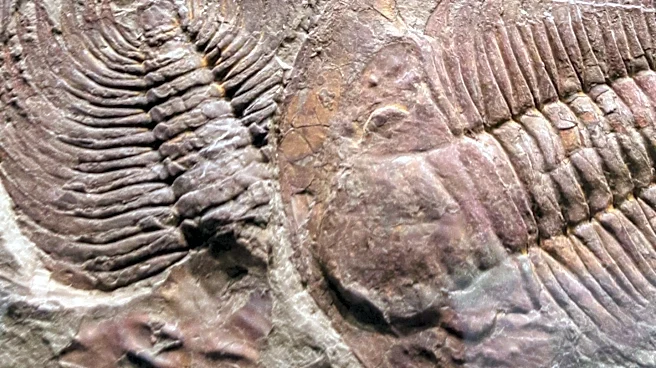
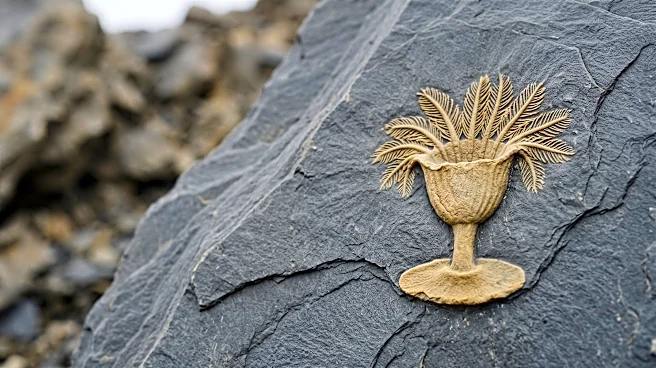
A recent discovery in the Fermeuse Formation of Newfoundland has unearthed Edrathina obditchia, an Ediacaran stem-group ctenophore. This fossil material, preserved as a positive moldic epirelief beneath a volcanic ash layer, was found at the approximately
551-million-year-old Inner Meadow Lagerstätte near Upper Island Cove. Researchers suggest affinities with the roughly 10-million-year-younger Cambrian stem-ctenophores of the epibenthic Dinomischidae due to comparable morphologies, supported by phylogenetic analyses. Edrathina obditchia distinguishes itself from Cambrian dinomischids by possessing a broader basal disc, interpreted as an adaptation for anchoring on Ediacaran microbial matgrounds, and having offset rather than opposite pinnules. This finding extends the known stem-ctenophore record into the Ediacaran period, providing crucial evidence for a more protracted period of metazoan evolution preceding the Cambrian radiation.
Why It's Important?
This discovery significantly impacts our understanding of early animal evolution, particularly the timeline leading up to the Cambrian Explosion. The presence of a stem-group ctenophore in the Ediacaran period challenges previous assumptions about the rapid diversification of metazoans during the Cambrian. It suggests that the evolutionary processes leading to complex animal forms were underway much earlier than previously thought, implying a longer and more gradual development of metazoan body plans. This pushes back the origins of key evolutionary innovations and provides a more complete picture of the biological landscape before the Cambrian radiation. For paleontologists and evolutionary biologists, Edrathina obditchia offers a critical data point for refining phylogenetic trees and understanding the environmental pressures and adaptations that shaped early animal life.
What's Next?
Future research will likely focus on further analyzing the morphological details of Edrathina obditchia and comparing it with other Ediacaran and Cambrian fossils to solidify its phylogenetic placement. Scientists will continue to explore other Ediacaran sites for similar discoveries that could further expand the metazoan fossil record. This will involve detailed comparative studies and potentially new dating techniques to refine the chronological context of these early life forms. The findings may also prompt a re-evaluation of existing hypotheses regarding the triggers and mechanisms of the Cambrian Explosion, potentially leading to new models of early animal diversification. Continued exploration of the Fermeuse Formation and similar geological sites could yield more insights into the Ediacaran biota and its relationship to later Cambrian life.
Beyond the Headlines
The identification of Edrathina obditchia as an Ediacaran stem-group ctenophore has broader implications for the concept of 'deep time' and the gradual nature of evolution. It underscores that major evolutionary transitions are often preceded by long periods of subtle development and experimentation, rather than sudden appearances. This discovery also highlights the importance of exceptional fossil preservation sites, known as Lagerstätten, which provide rare glimpses into the soft-bodied organisms that typically do not fossilize well. Understanding these ancient ecosystems can offer insights into fundamental biological principles, such as the origins of multicellularity, the development of complex body plans, and the interplay between life and Earth's changing environment over geological timescales. It reinforces the idea that the history of life is a continuous, interconnected narrative, with roots extending far deeper than previously imagined.