






What's Happening?
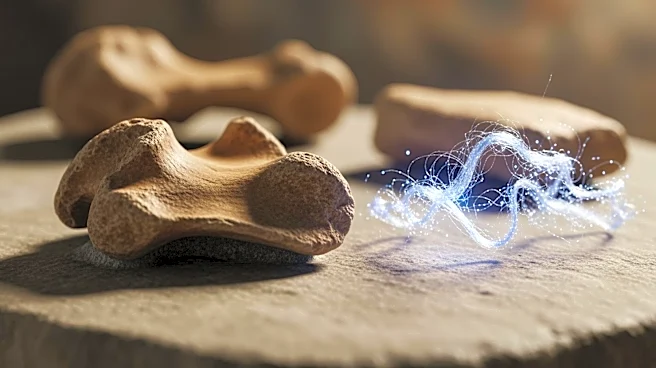
A team led by Qiaomei Fu at the Institute of Vertebrate Paleontology and Paleoanthropology in Beijing has successfully extracted proteins from six teeth believed to belong to Homo erectus, dating back approximately 400,000 years. These teeth were found
at various sites in China, including Zhoukoudian, Hexian, and Sunjiadong. The study revealed that these proteins share similarities with those found in Denisovans, suggesting possible interbreeding between the two hominin groups. This discovery provides new insights into the relationships and interactions between ancient human species in Asia.
Why It's Important?
The findings are significant as they offer a deeper understanding of human evolution, particularly the interactions between different hominin species. The potential interbreeding between Homo erectus and Denisovans could explain certain genetic traits found in modern humans. This research also highlights the importance of protein analysis in paleontology, offering a new method to study ancient species where DNA may not be preserved. The study could reshape our understanding of human ancestry and migration patterns across Asia.
What's Next?
Further research is needed to confirm the identity of the teeth and the extent of interbreeding between Homo erectus and Denisovans. Additional fossil discoveries and molecular data will be crucial in resolving these uncertainties. The study opens new avenues for exploring ancient human interactions and could lead to more discoveries about the genetic legacy of these early hominins in modern populations.