






What's Happening?
Nexdata, an AI training data provider, has successfully completed a 10,000-hour Ego-Exo multi-view data collection project. This project involved delivering synchronized human demonstrations to a leading AI company to support the development of Physical
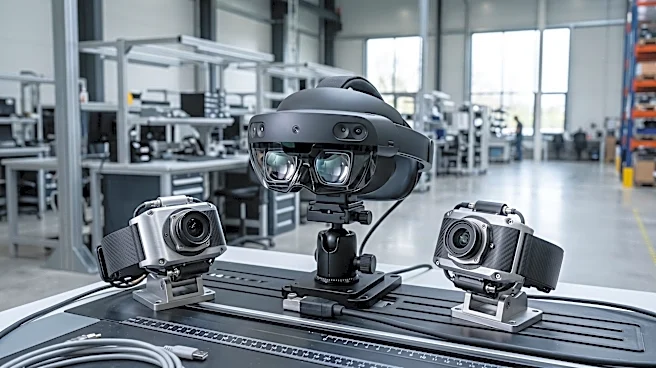
AI. The data collection utilized five time-synchronized devices for each setup: one stereo head-mounted device, two wrist-mounted cameras, and two external cameras. These devices collectively recorded hand-object interactions, workspace context, and full-body movements. This multi-perspective approach allows researchers to analyze the same action from complementary viewpoints. The collection covered various factory and warehouse workflows, including component assembly, tool handling, goods sorting, shelf picking, and packing, with recording limited to eight hours per scene to ensure environmental diversity. Nexdata employed AI-assisted checks and manual reviews to ensure data quality, achieving a pass rate of up to 98% for task authenticity, camera synchronization, visibility, and recording completeness.
Why It's Important?
This data delivery by Nexdata is crucial for the advancement of Physical AI in the U.S. and globally, particularly for industries relying on automation and robotics. By providing high-quality, synchronized multi-view data, Nexdata is enabling AI companies to develop more sophisticated and capable robots that can understand and replicate complex human manipulation tasks. This has direct implications for manufacturing, logistics, and other sectors where robots are increasingly being deployed. Improved robot learning can lead to greater efficiency, reduced operational costs, and enhanced safety in environments like factories and warehouses. The ability of robots to perform intricate tasks with human-like precision can transform supply chains and production processes, making U.S. industries more competitive and resilient. This development also addresses the growing demand for robust training data, which is a bottleneck in many AI development efforts.
What's Next?
The successful delivery of this extensive dataset by Nexdata is expected to accelerate the development and deployment of Physical AI applications. The availability of such detailed and synchronized data will allow AI researchers and engineers to train more advanced robot learning models, leading to robots with improved dexterity and contextual understanding. This could pave the way for new generations of industrial robots capable of performing a wider array of tasks with greater autonomy. Nexdata's demonstrated capability in coordinating multi-device collection and ensuring high data quality suggests that similar large-scale data projects will continue to be vital for the progression of AI. Future developments will likely include the integration of these advanced robotic systems into more complex operational workflows, potentially leading to fully autonomous factories and warehouses.
Beyond the Headlines
The development of Physical AI, fueled by datasets like those provided by Nexdata, raises profound questions about the future of work and human-robot collaboration. As robots become more adept at human-like tasks, there will be significant shifts in labor markets, requiring new skills and potentially redefining job roles. Ethical considerations regarding robot autonomy, safety in shared workspaces, and the societal impact of widespread automation will become increasingly prominent. Legally, frameworks for liability in cases of robotic error or malfunction will need to evolve. Culturally, the integration of highly capable robots into daily life and industrial settings will challenge existing perceptions of technology and human capabilities. This advancement is not just about technological progress but also about navigating the complex interplay between humans, machines, and society.