
What's Happening?
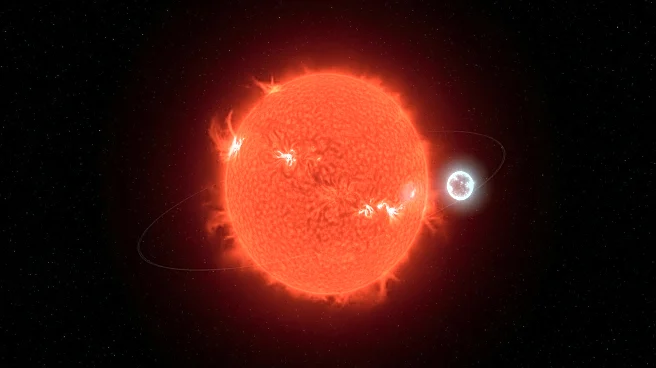
The Hubble Space Telescope, along with ground-based observatories, has confirmed the existence of a companion star to Betelgeuse, named Siwarha. This discovery was made by detecting the wake of the companion star,
which is composed of denser material than the surrounding gases. The presence of Siwarha helps explain Betelgeuse's unusual behavior, such as its dimming and brightening. The findings were presented at the American Astronomical Society meeting, providing direct evidence of the companion star's influence on Betelgeuse.
Why It's Important?
The confirmation of Siwarha's existence is significant as it provides a better understanding of the dynamics of red supergiant stars like Betelgeuse. This discovery offers insights into how such stars evolve, shed material, and eventually explode as supernovae. Understanding these processes is crucial for astronomers studying stellar evolution and the life cycles of massive stars. The findings also highlight the capabilities of the Hubble Space Telescope in uncovering hidden aspects of well-known celestial objects.
What's Next?
Researchers plan to conduct further observations of Siwarha when it becomes visible again in 2027. These observations will help refine our understanding of the companion star's impact on Betelgeuse and its role in the star's evolution. The study's results will be published in The Astrophysical Journal, contributing to ongoing research on red supergiant stars and their companions.