







What's Happening?
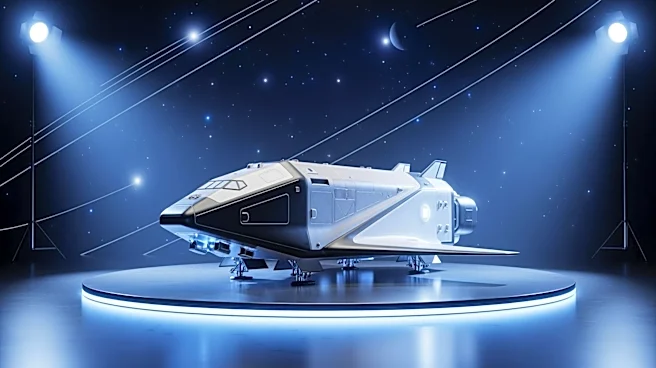
China has shortlisted four commercial rocket companies to launch a new low-cost cargo spacecraft for its space station. The companies—Galactic Energy, CAS Space, OrienSpace, and Landspace—are set to launch the Qingzhou cargo spacecraft, which is developed
by the Innovation Academy for Microsatellites of the Chinese Academy of Sciences. The spacecraft is part of a program initiated by China's human spaceflight agency to support the Tiangong space station. The full-scale Qingzhou is scheduled for launch in January 2027, aiming to dock at Tiangong for the first time. This initiative is part of China's broader efforts to expand its space capabilities and reduce costs.
Why It's Important?
The shortlisting of commercial launch providers marks a significant step in China's strategy to integrate private companies into its national space program. This move could enhance the efficiency and cost-effectiveness of China's space operations, potentially accelerating its space exploration and development goals. By involving commercial entities, China is likely to foster innovation and competition within its space industry, which could lead to technological advancements and increased global competitiveness. The development of low-cost cargo spacecraft is crucial for sustaining long-term operations of the Tiangong space station and could pave the way for more ambitious space missions.
What's Next?
The shortlisted companies will continue to develop and test their launch capabilities in preparation for the scheduled launch of the Qingzhou spacecraft in 2027. The final selection of a launch provider will depend on the readiness and performance of the companies' respective rockets. As China continues to expand its space station and explore new space technologies, further collaborations with commercial entities are expected. This could lead to more opportunities for private companies in China's space sector, potentially influencing global space industry dynamics.